“SaaStorm is the first SEO team I’ve worked with that reported on demos and customers rather than traffic. In seven months they built a content base that started showing up in AI answers and brought us real pipeline, and when we pushed on the numbers, they answered straight.”



When we started working with Jimo, it was clear they were competing in a crowded and complex digital adoption market. As a bootstrapped company, Jimo was up against legacy players with larger content footprints, more resources, and years of search history.
The path forward was clear: Jimo needed to prove that inbound could become a reliable source of qualified demand and revenue. So that’s exactly what we set out to build.
Seven months later, Jimo had 43 MQLs and €100K in qualified pipeline, alongside €16K+ in closed-won ARR against a €42K investment. A hybrid content production approach drove 280% growth in blog clicks and carved out a 5% share of LLM responses.
This is how we turned a challenging category, a lean team, and a standing-start search presence into a measurable inbound content engine.
Before SaaStorm:
- Underdeveloped blog and glossary traffic
- No strategic direction tying existing content together
- No established inbound pipeline
With SaaStorm:
- +280% increase in blog clicks
- 43 MQLs, 17 of them from LLM referrals
- €100K in qualified inbound pipeline
Impact


The challenge
When we started working with Jimo, they already had content in place, but no strategic direction tying it together.
Jimo’s existing pages covered topics like onboarding, product adoption and related concepts, but nothing connected those topics to Jimo’s differentiators or made a case for why buyers should choose them.
Search intent was difficult to untangle. A term like “onboarding” can mean employee onboarding, customer onboarding or product onboarding. That made raw search volume a poor proxy for the opportunities that actually mattered.
More importantly, the content wasn’t positioning Jimo as a serious contender in its category. Jimo needed more than content that answered questions. It needed content that could move a buyer from “I’m researching this problem” to “Jimo could be the answer.”
The solution (SaaStorm’s approach)
We started with our discovery phase in January 2026 before launching a seven-month engagement in February.
During discovery, we audited Jimo’s existing organic presence, content, competitors and search opportunities to find the biggest gaps and the clearest path from organic search to revenue.
Here’s what we delivered:




The SaaS marketing strategy for Jimo
Discovery gave us a clear roadmap for turning Jimo’s existing and future content into a focused, revenue-driven organic growth engine. The strategy centred on finding the right search opportunities, building a structure around them, and creating the technical and authority foundations needed to turn them into qualified traffic and, ultimately, pipeline.
Here’s how we did it:
01. Extensive keyword research
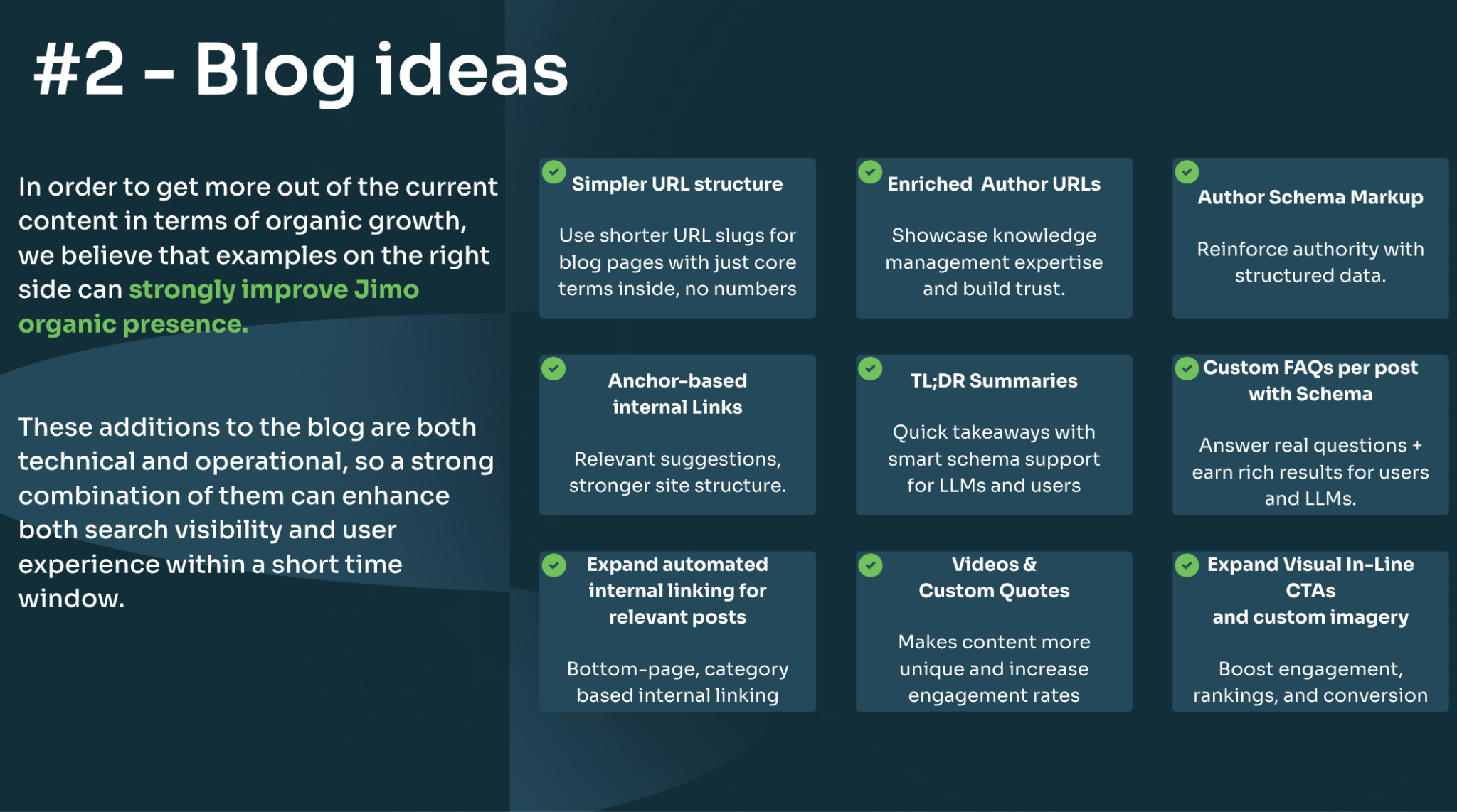
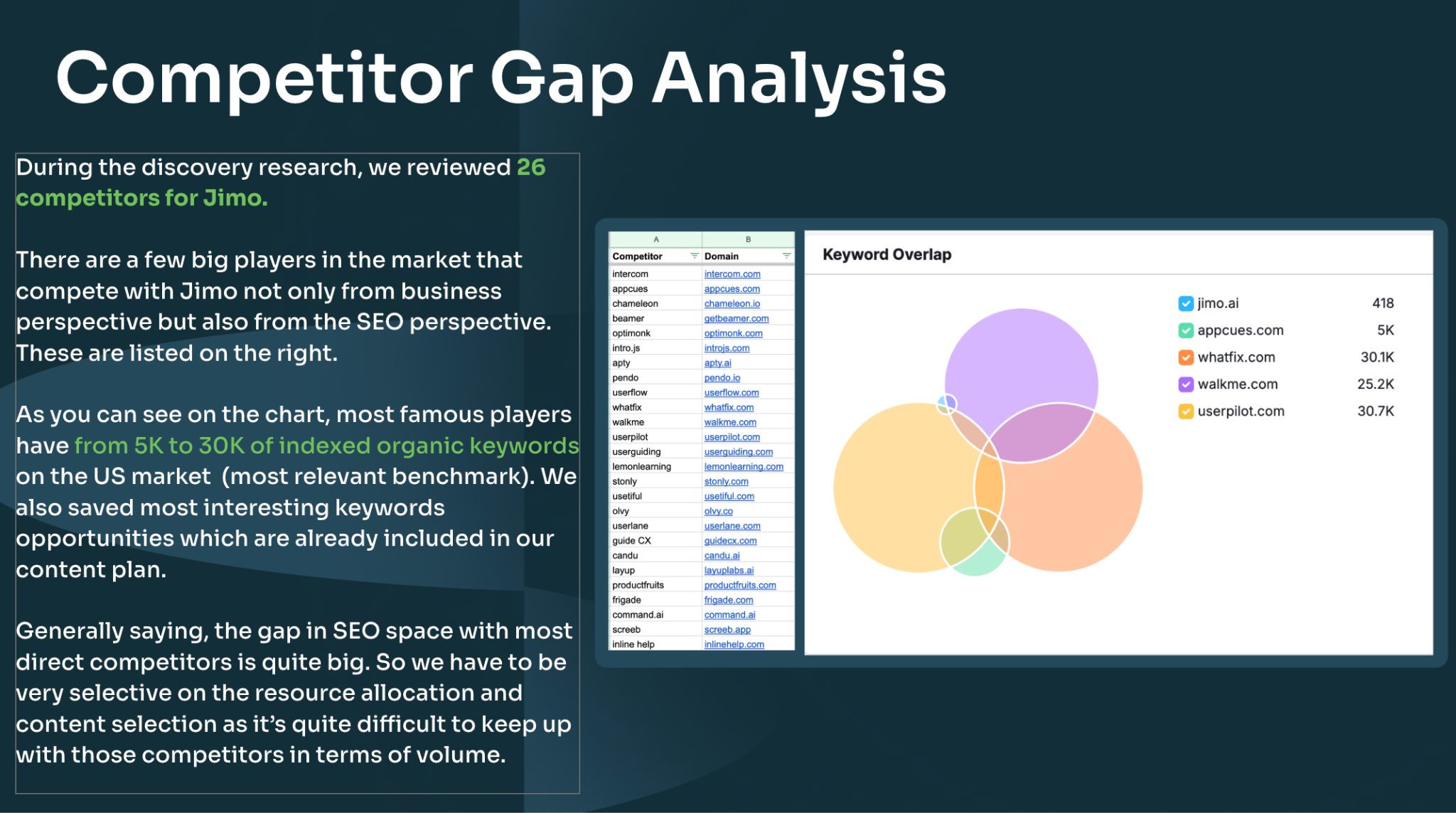
We went beyond search volume to identify the keywords that mattered for Jimo’s ICP, with a particular focus on MOFU and BOFU opportunities. Given the ambiguity of Jimo’s category, that meant starting with a deep dive into Jimo’s competitors and separating broad terms from searches that showed genuine interest in product adoption and onboarding, the problems Jimo solves.
02. Building topic clusters
With the keyword landscape mapped, we organised opportunities into topic clusters around Jimo’s core areas of expertise.
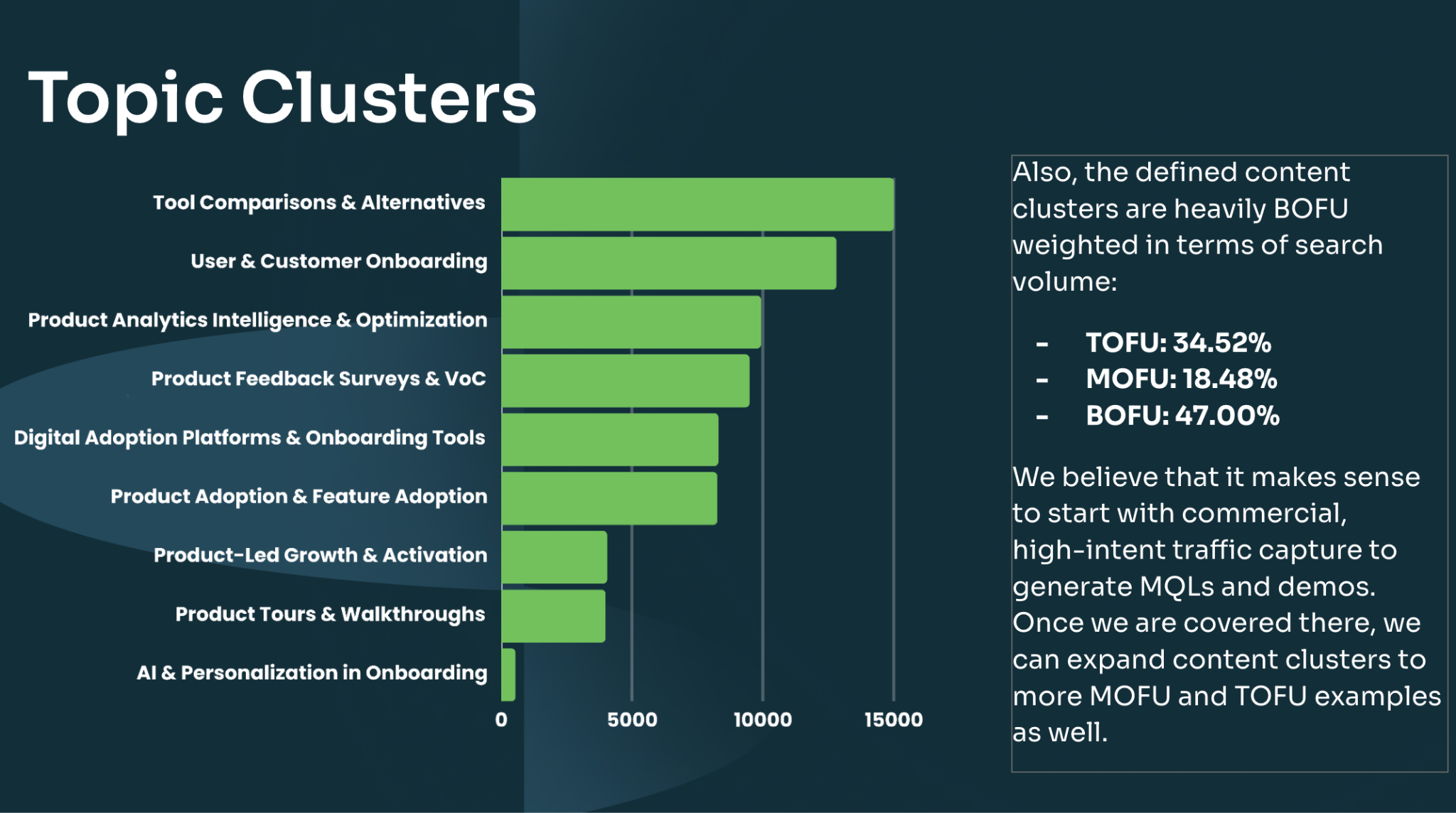
This gave us a clearer content architecture: pillar topics could establish Jimo’s authority, while supporting articles captured more specific searches and brought qualified prospects deeper into the site.
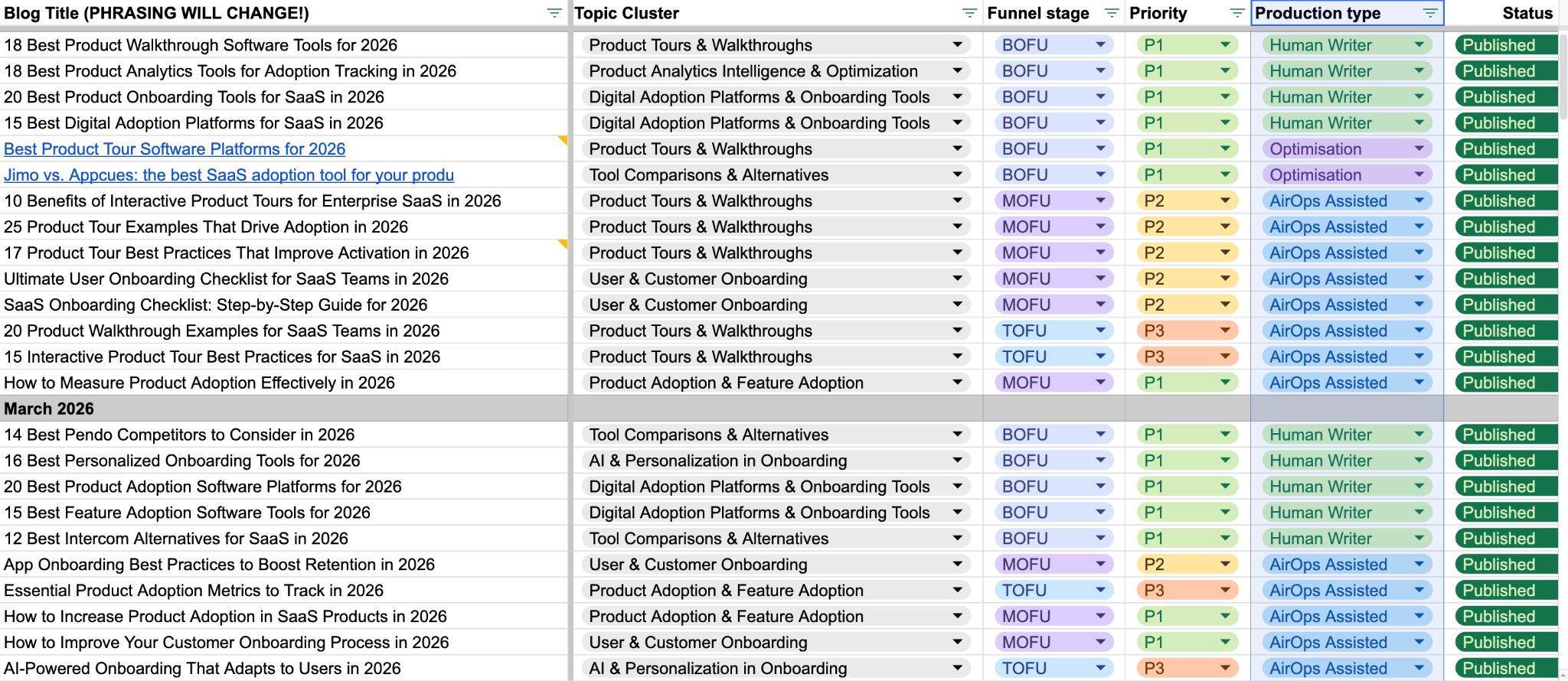
03. Combining human-written and AI-assisted content
With the strategy in place, we built a content production process that combined AirOps-assisted workflows with human expertise. Not every piece needed the same approach. For broader topics, we used AirOps to accelerate content creation, and every piece was then edited, fact-checked and proofed by a human before publication.
For more strategic, commercially important topics, we took a different approach. AirOps helped merge research, sales call insights and angles into a tailored content framework, and our content writer added the nuance, positioning and argumentation Jimo’s most important topics needed.
⚡Focus on BOFU Content:
- 12 Best Digital Adoption Platforms for SaaS in 2026
- 10 Best Chameleon Alternatives for Product Tours in 2026
- Pendo vs Walkme – key differences for 2026
- How to Reduce Onboarding Time Without Hurting Adoption in 2026
- Enterprise SaaS Onboarding Strategies That Scale in 2026
The goal was to meet buyers where they were already looking for answers. We used insights from sales calls alongside Google and LLM research to uncover the pain points, objections and competitive questions shaping Jimo’s buyers’ decisions.
“The AirOps-powered briefs gave me a fantastic starting point with context already mapped out. But BOFU content needs a person who understands the market to craft convincing prose. I focused on pieces where buyers were evaluating Jimo against competitors, as those truly needed a human writer to nail the strategic positioning and argumentation.”
Michelle Newblom, Content Writer at SaaStorm
⚡Focus on AirOps Workflows
- How Interactive Product Tours Accelerate SaaS Sales Cycles: 7 Proven Benefits (+ ROI Framework)
- SaaS Onboarding Checklist: A Step-by-Step Guide for 2026
- Product Adoption Guide: Strategies, Metrics, and Tools for 2026
- How to Write Release Notes That Drive Feature Adoption
04. The content production workflow
Once the strategic framework was in place, we looked for opportunities to automate the research and preparation work around content. We built AirOps workflows around three jobs: brief generation, content creation and content updates.
Content brief generation
AirOps turned our keyword and strategic inputs into structured briefs, giving our writer a consistent starting point while cutting the manual research behind each piece. Drawing on sales transcripts, ICP refinement and more, the briefs went well beyond surface-level research. Here’s the repeatable process we built for both human-written and AI-assisted briefs.
1. The inputs we used
Each run starts with a primary keyword and a few strategic inputs: the funnel stage, the pain point the article should address, Jimo’s role in the piece, and the brief type. Two knowledge bases, Jimo’s ICP and its brand style guide, are attached to every run, so the strategy travels with the keyword. To maintain semantic relevance, we also feed in a SurferSEO link that lists the entities associated with the target keyword.
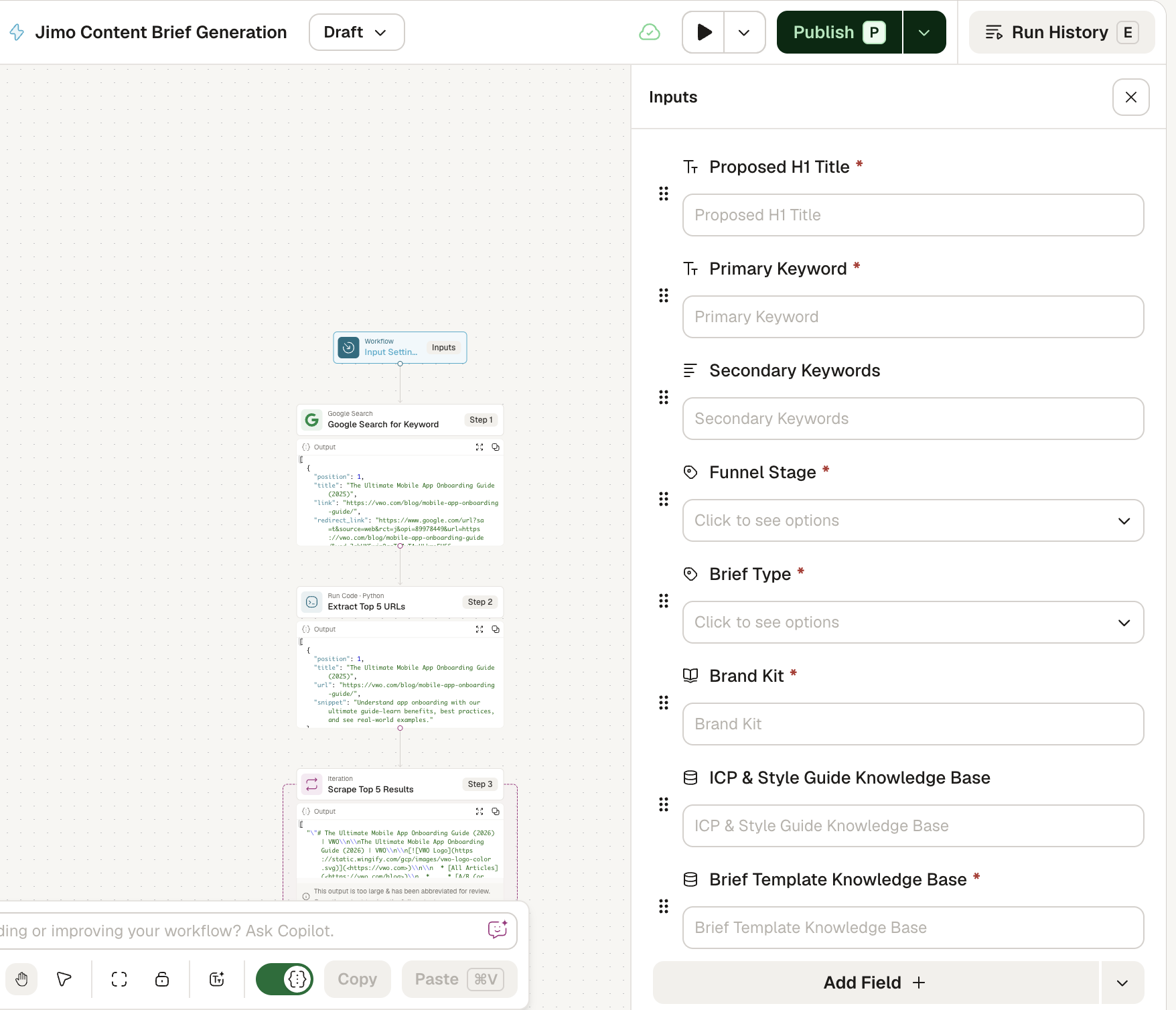
2. Workflow overview
From there, the workflow runs in seven stages: competitive research, audience questions, ICP and messaging context, competitor analysis, brief generation, a branch by brief type, and transfer to a Google Doc.
3. Competitive benchmarks
The top five ranking pages are scraped and analysed for structure, positioning, topic coverage and gaps. A code step turns that analysis into concrete targets such as word count, number of H2s and must-have elements, so the brief is sized to what already ranks. The workflow also collects the keyword’s People Also Ask questions, and when Google shows none, it generates ICP-relevant questions instead.
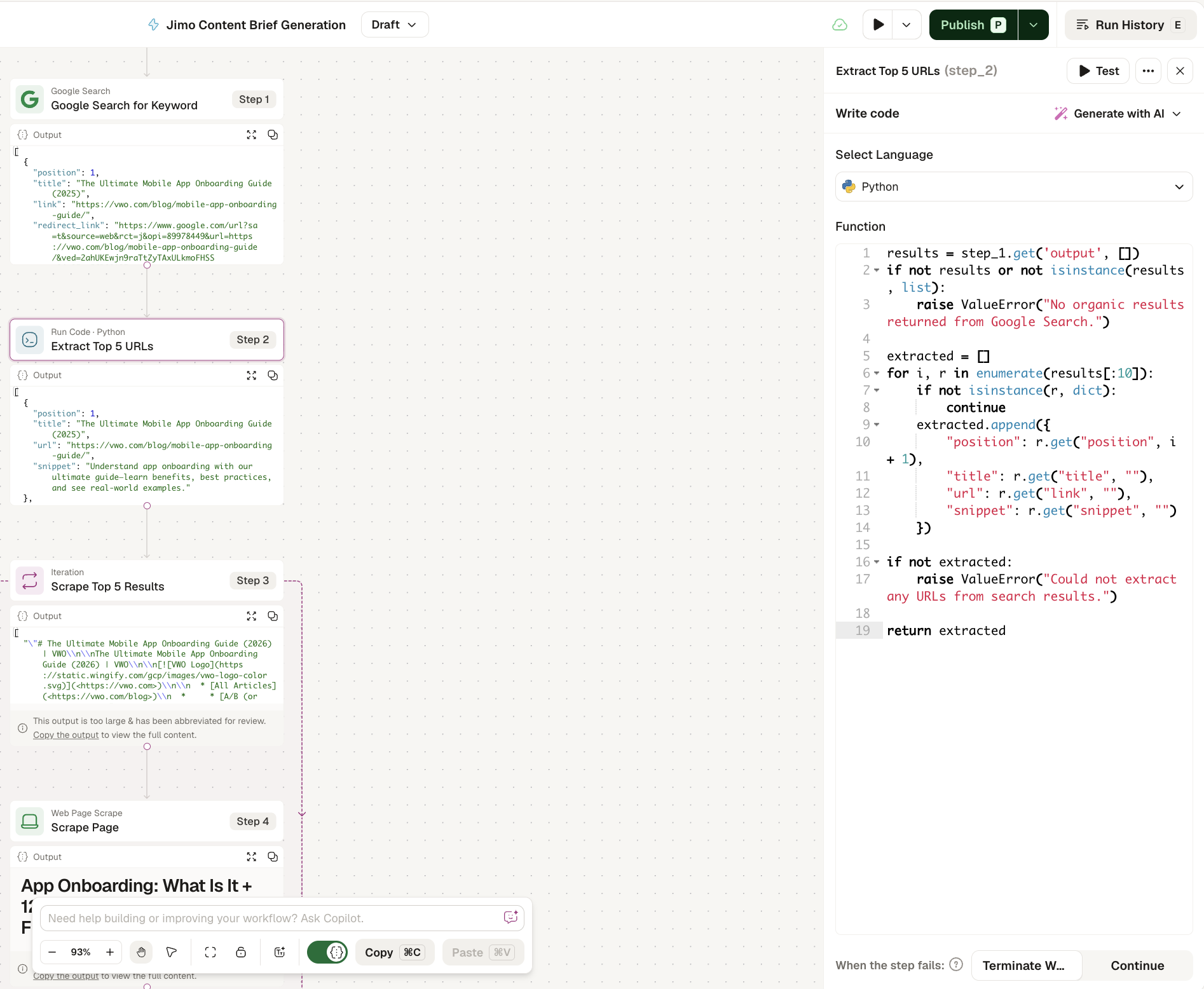
4. ICP knowledge base search
Before anything is written, the workflow searches Jimo’s ICP knowledge base for the personas and pain points most relevant to the keyword. It also pulls matching proof points and messaging angles from the Brand Kit. An LLM condenses both into a short strategic reference that the later steps build on.
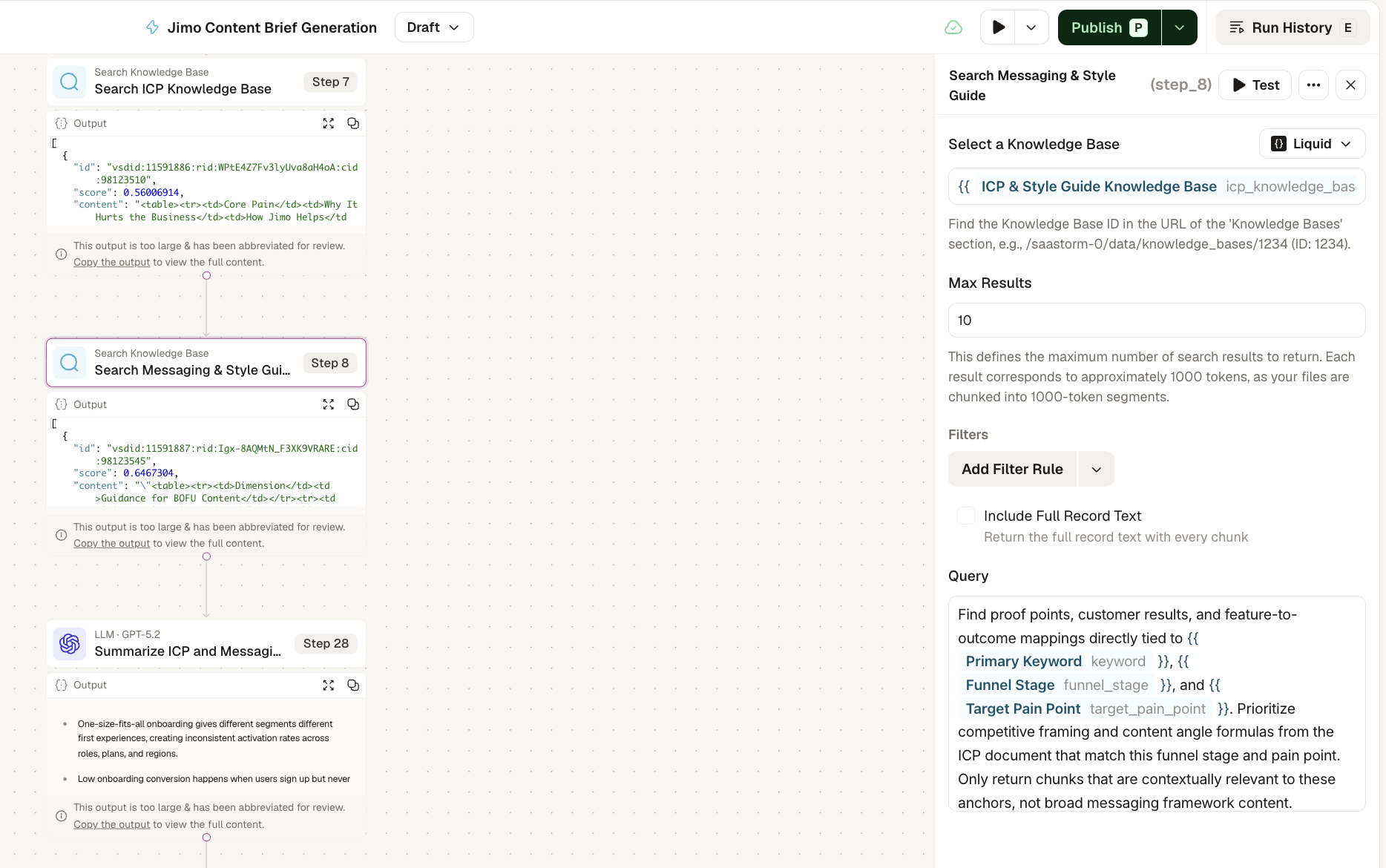
5. Section directives
The brief is built around a narrative spine, then broken down section by section. For each H2, the workflow writes a dedicated directive covering talking points, keyword placement and CTA placement, so every part of the outline has specific guidance.
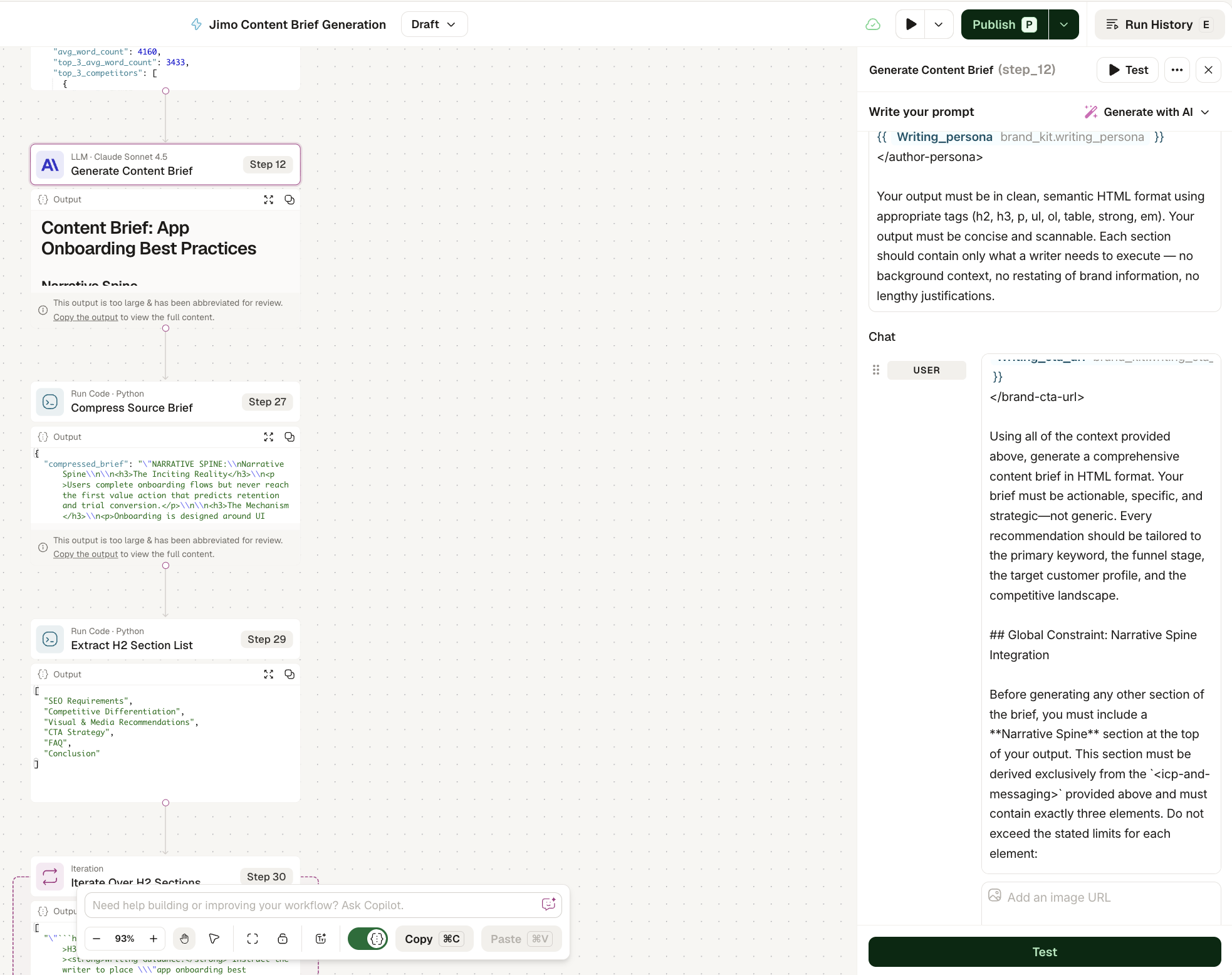
6. Two brief formats
The workflow then branches depending on who will write the article. For AI-assisted content, the brief is more detailed and prescriptive, with explicit direction for every section, because AI can’t infer intent the way a human writer can. It’s built in two passes: the first drafts the metadata table and post structure, and the second fills any gaps before the two are combined.
For handoff to our content writer, the brief covers the same ground in a leaner form. The key direction is there, and the writer has room to apply their own judgment and craft.
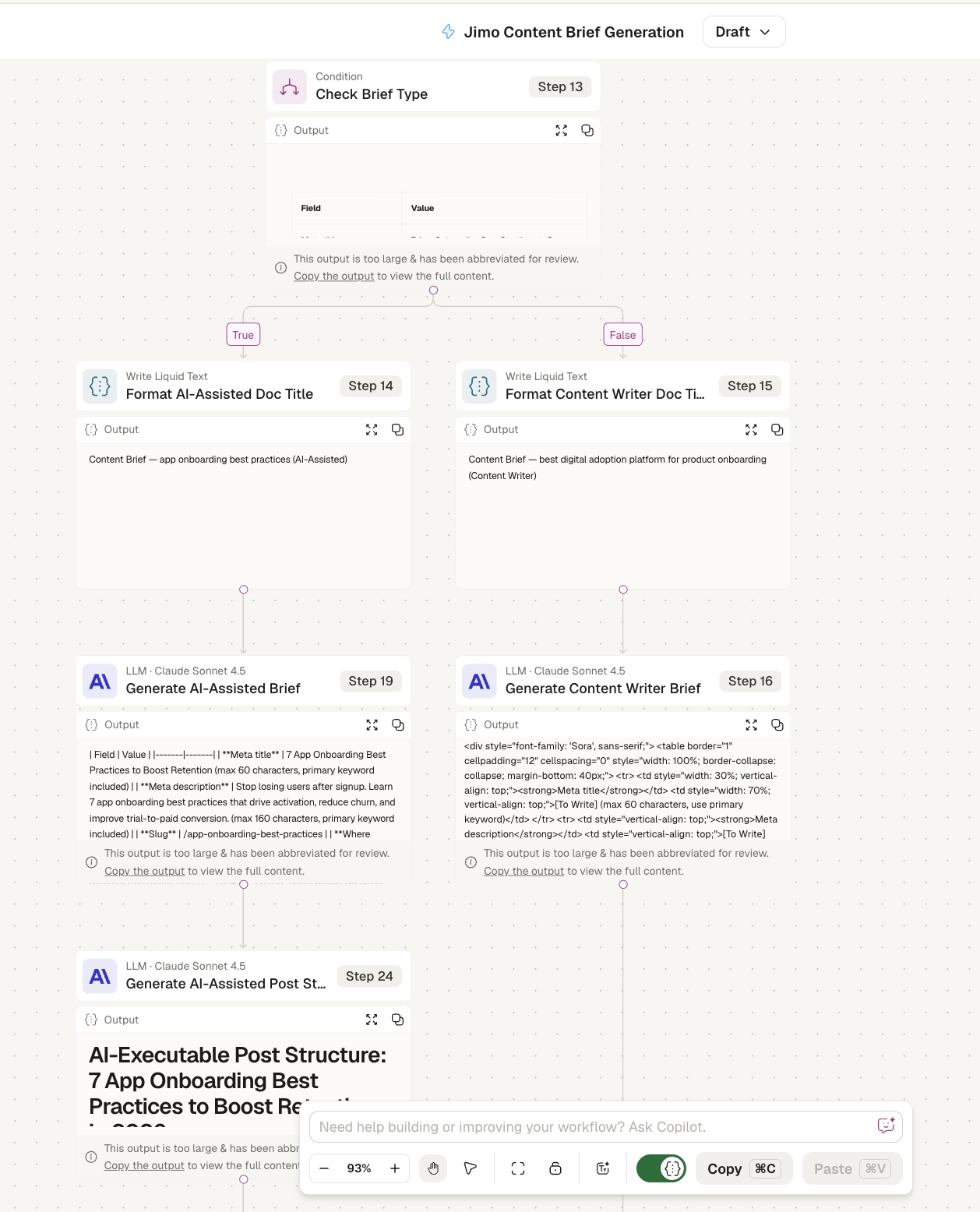
7. The finished brief
The brief is saved as a Google Doc in the right folder, formatted either for a content writer or for the AI-assisted writing workflow, depending on the brief type.
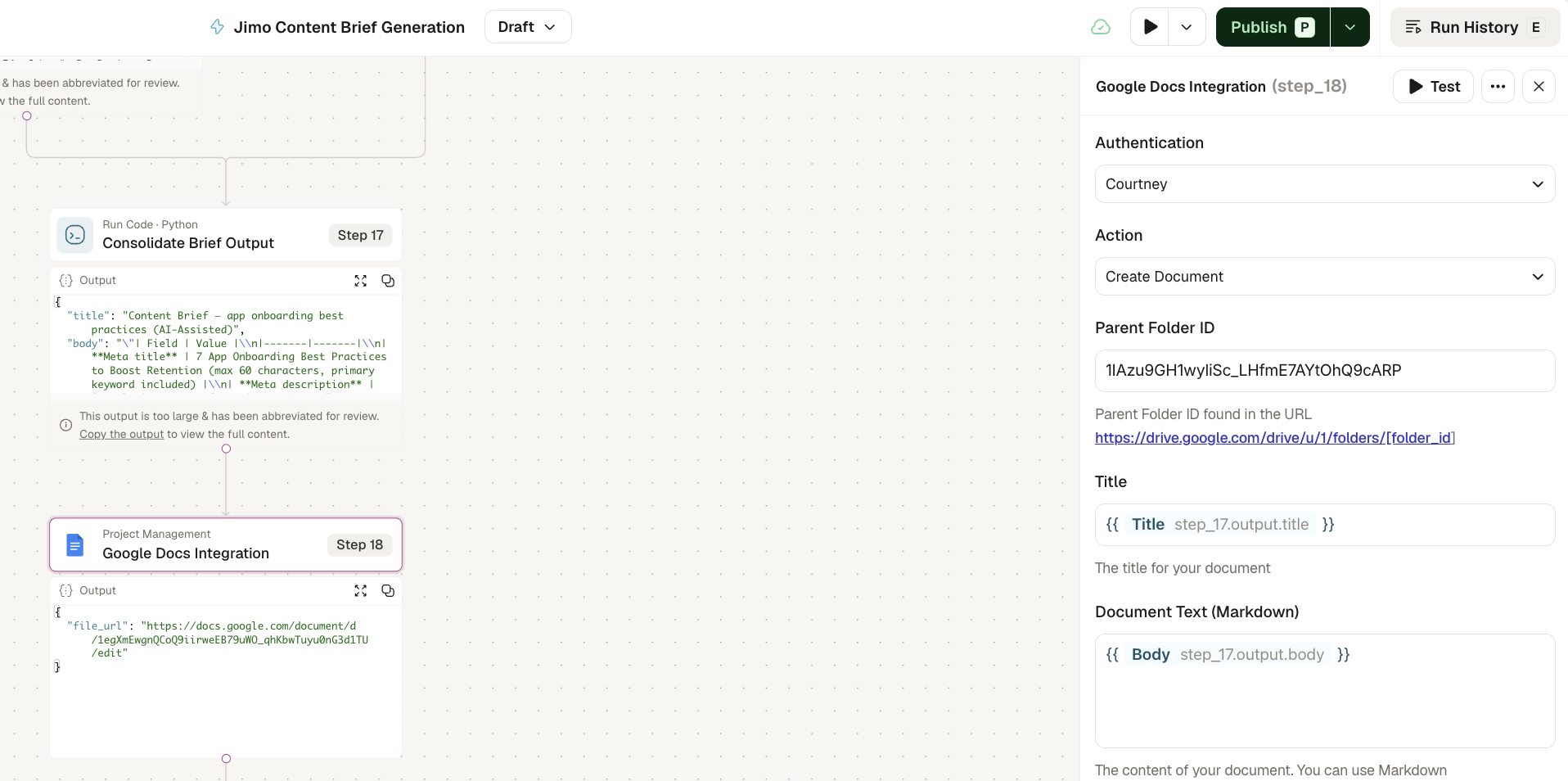
Content creation
With the brief ready, the next step is bringing everything together. For AI-assisted content, we built in brand style guidelines, persona-tailored language and internal linking guidance, producing drafts that balance on-brand messaging with content built to perform in the SERPs. Here’s the process we followed for Jimo.
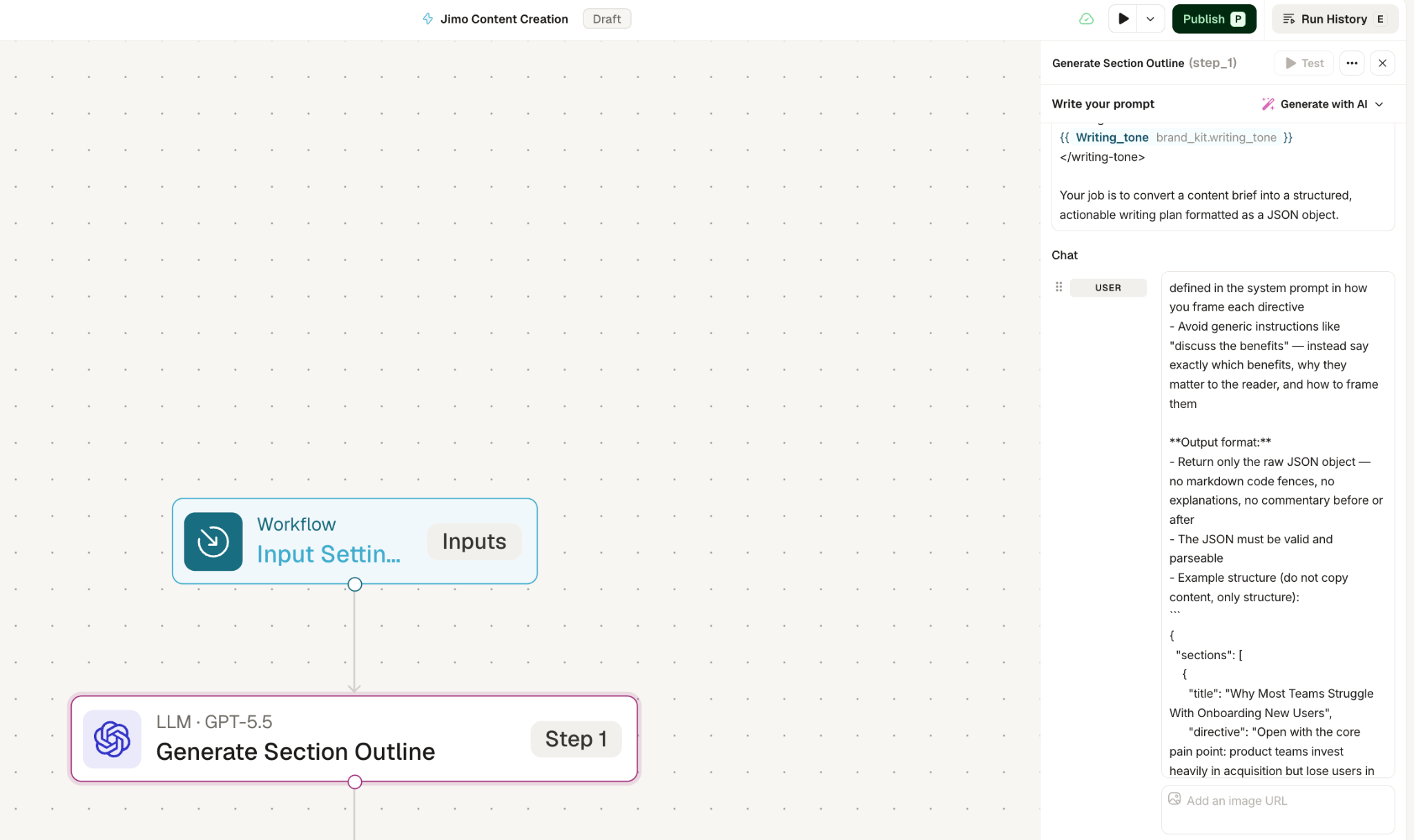
1. Section outline
The workflow doesn’t generate the whole article from a single prompt. It plans first, then writes one section at a time. GPT-5.2 converts the brief into a structured writing plan of five to eight sections, each with a title and a directive covering what to cover, the angle to take, the structure (H3s, bullet points and so on), and the key points and CTAs to include.
2. Writing in the brand’s voice
Claude Sonnet 4.6 then writes each section individually, following its directive. The prompt draws on the Brand Kit’s writing persona, tone, brand context and a writing sample, so every section reads in Jimo’s voice.
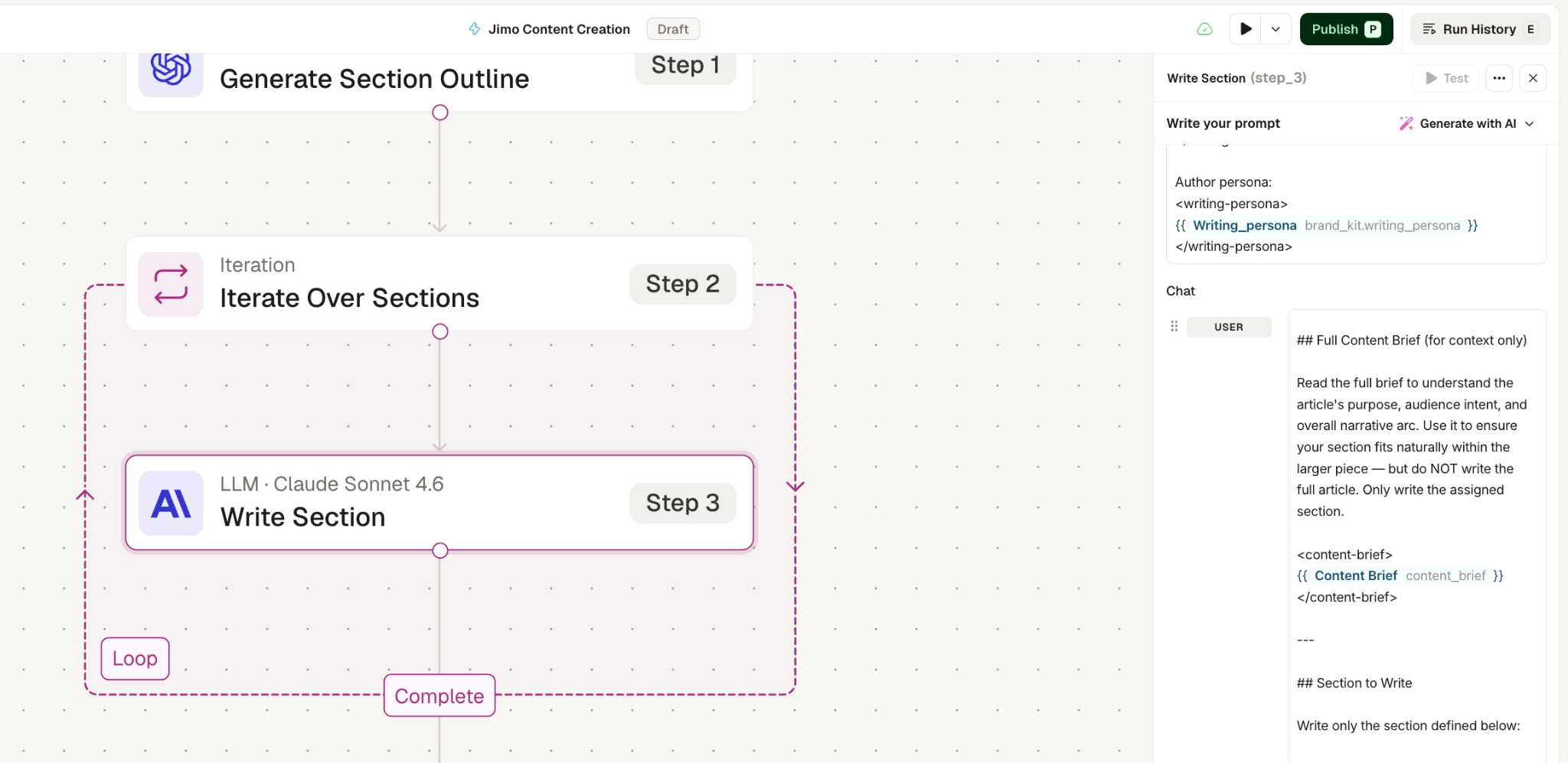
3. One section at a time
Writing section by section keeps each part focused on its directive. A short code step then joins the sections into one Markdown article.
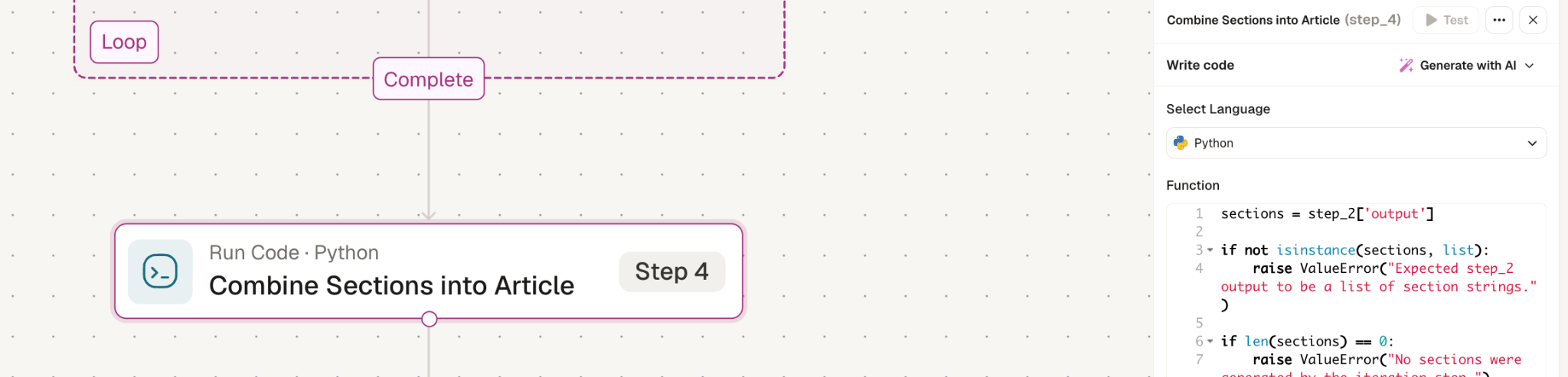
4. Internal links
In the final step, Claude Sonnet 4.6 adds internal links using only anchor text that’s already in the article. Each URL is used once, and no copy is added or changed, so the article’s structure and wording stay as written.
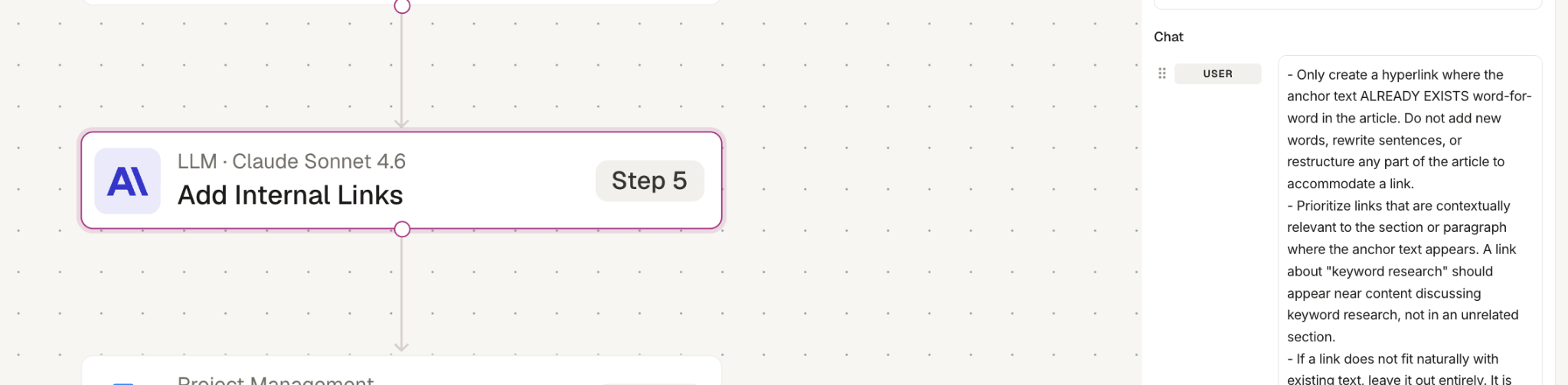
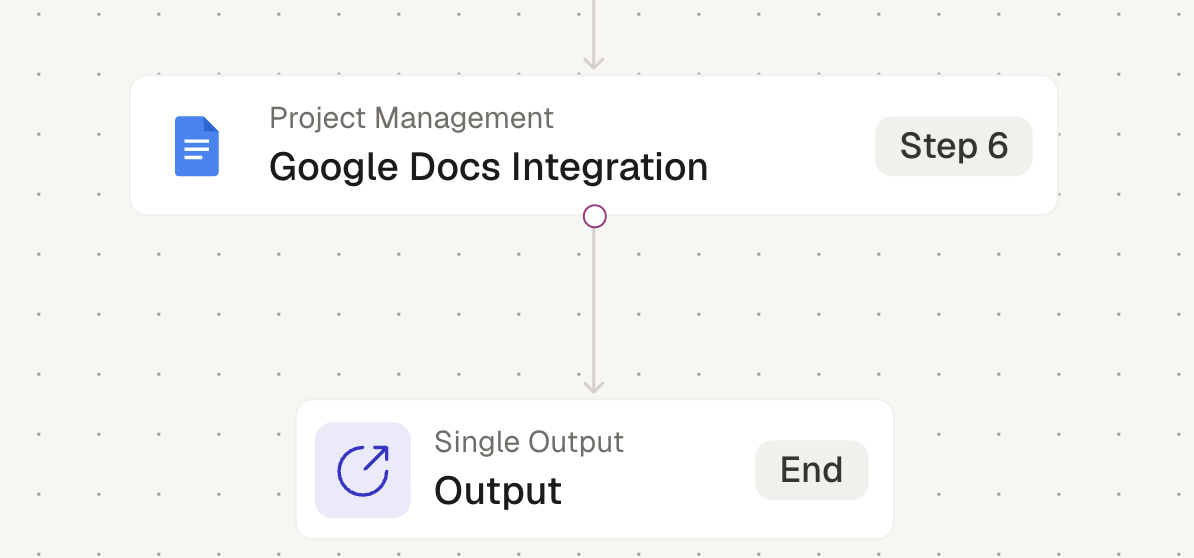
5. Final draft as a Google Doc
The finished draft is delivered as a Google Doc in the same folder as its brief.
Content updates
As Jimo’s product messaging evolved, we wanted content optimisation to keep pace. We used AirOps Playbooks to find existing content that needed updating and surface refresh opportunities systematically, rather than relying on a manual page-by-page review. Here’s how it works.
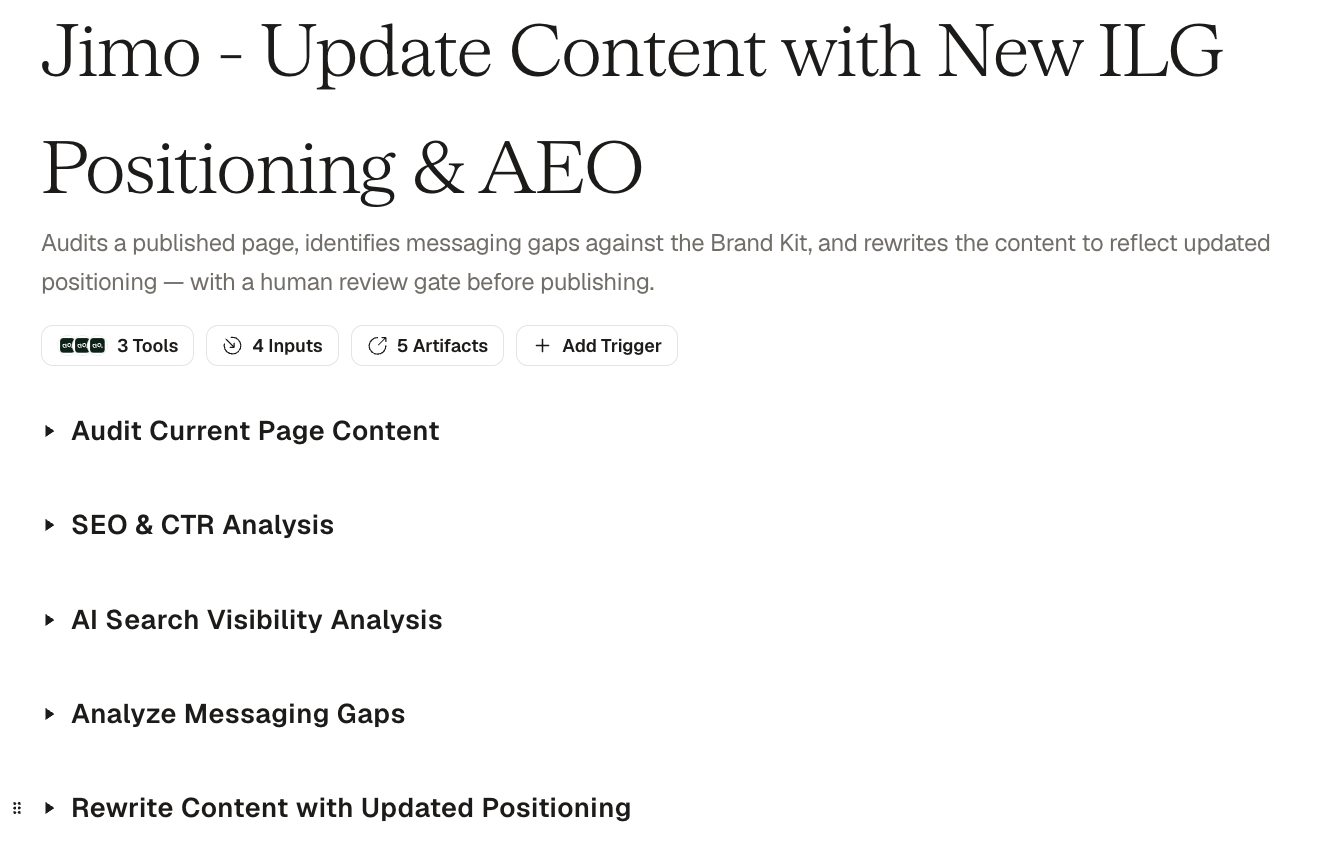
1. Playbook overview
The playbook runs five analyses in sequence, each producing a documented output that feeds the final rewrite. It starts with an audit of the live page, covering title, meta, headings, body copy, CTAs and word count, and flags existing positioning claims as priority areas.
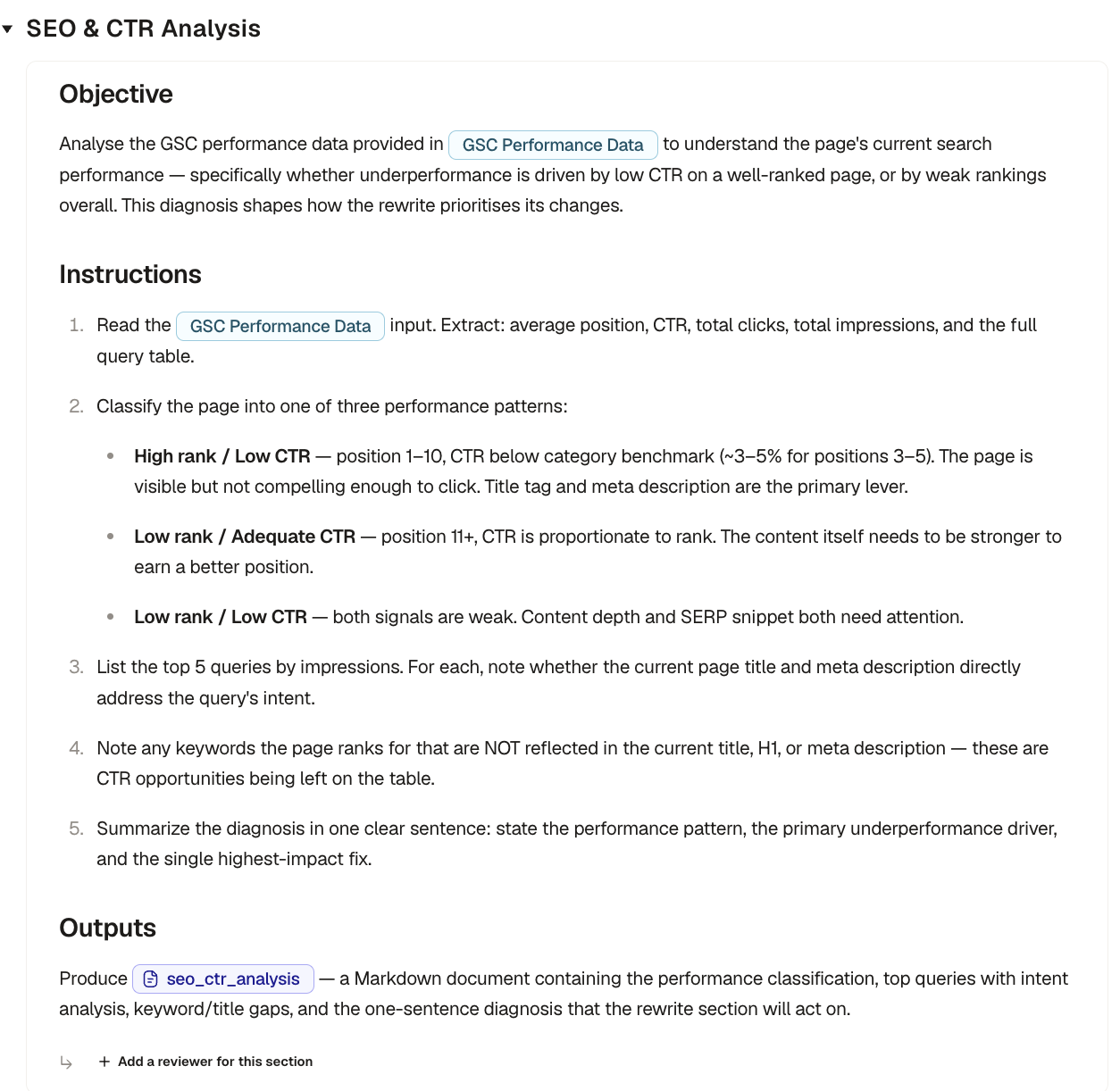
2. SEO and CTR analysis
Search Console data shows whether the page has a visibility problem, meaning it doesn’t rank well enough, or a click-through problem, where it ranks but people don’t click. The page is classified into one of three patterns, and keyword and title gaps are called out.
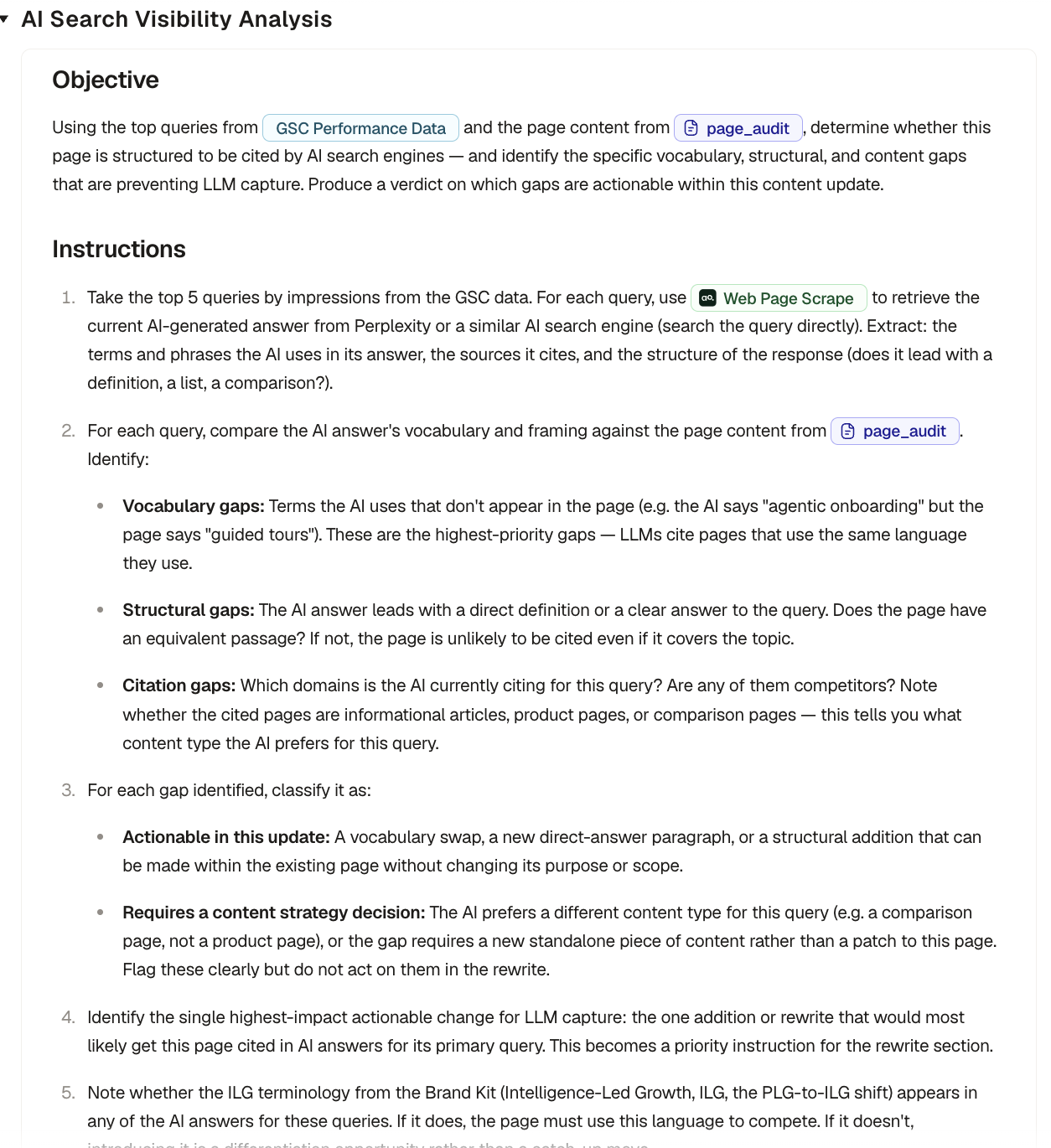
3. AI search visibility
Next, the playbook checks how AI engines answer the page’s top queries and compares their language and structure with the page. It surfaces missing vocabulary, missing direct-answer structure, and which sources get cited instead. Each gap is marked as fixable in this rewrite or as needing a broader content strategy decision.
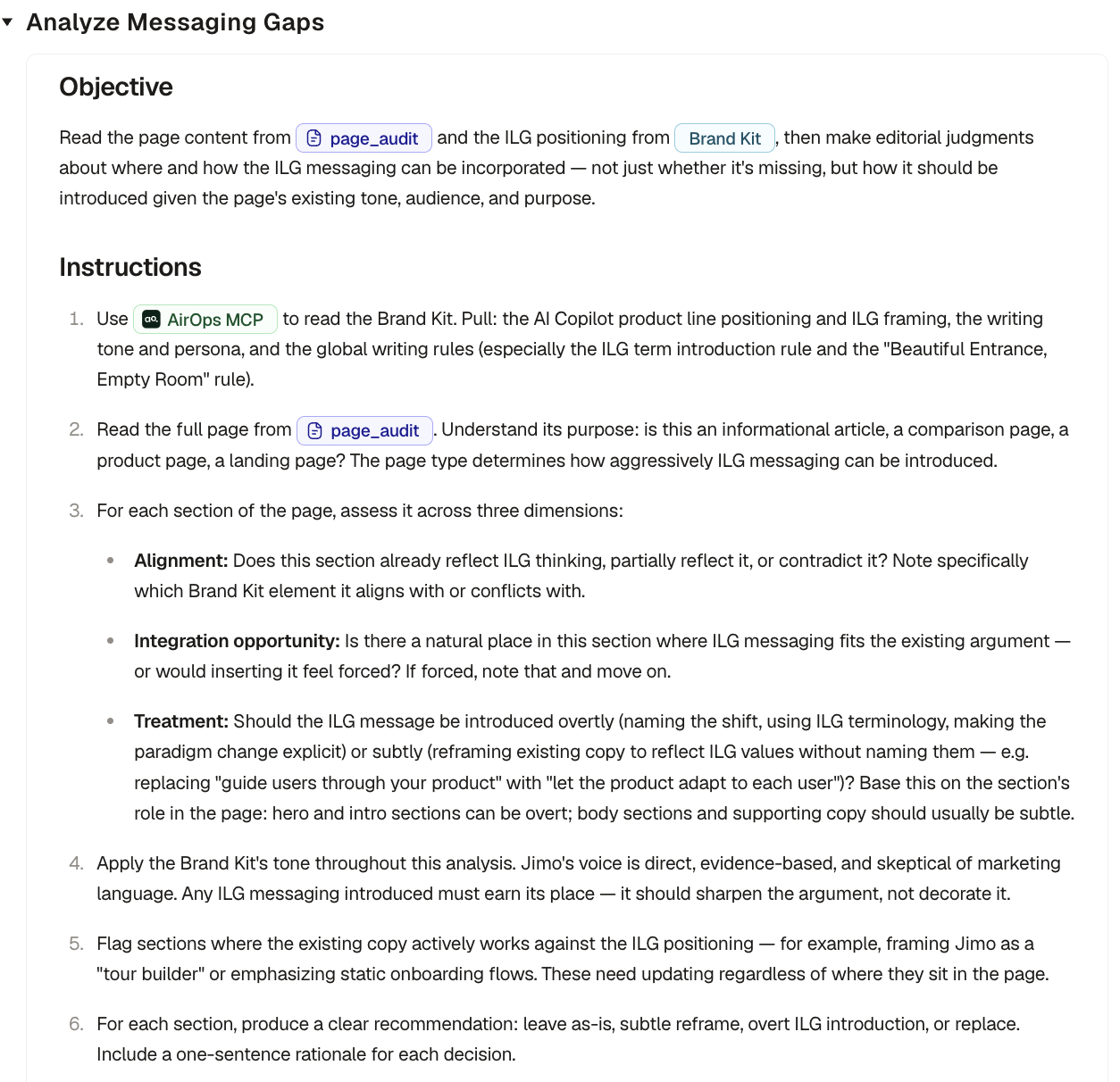
4. Messaging gap analysis
Each section is checked against the Intelligence-Led Growth (ILG) positioning and writing rules in Jimo’s Brand Kit and judged as aligned, in conflict, or open to introducing ILG messaging. The analysis also sets how prominent that messaging should be.
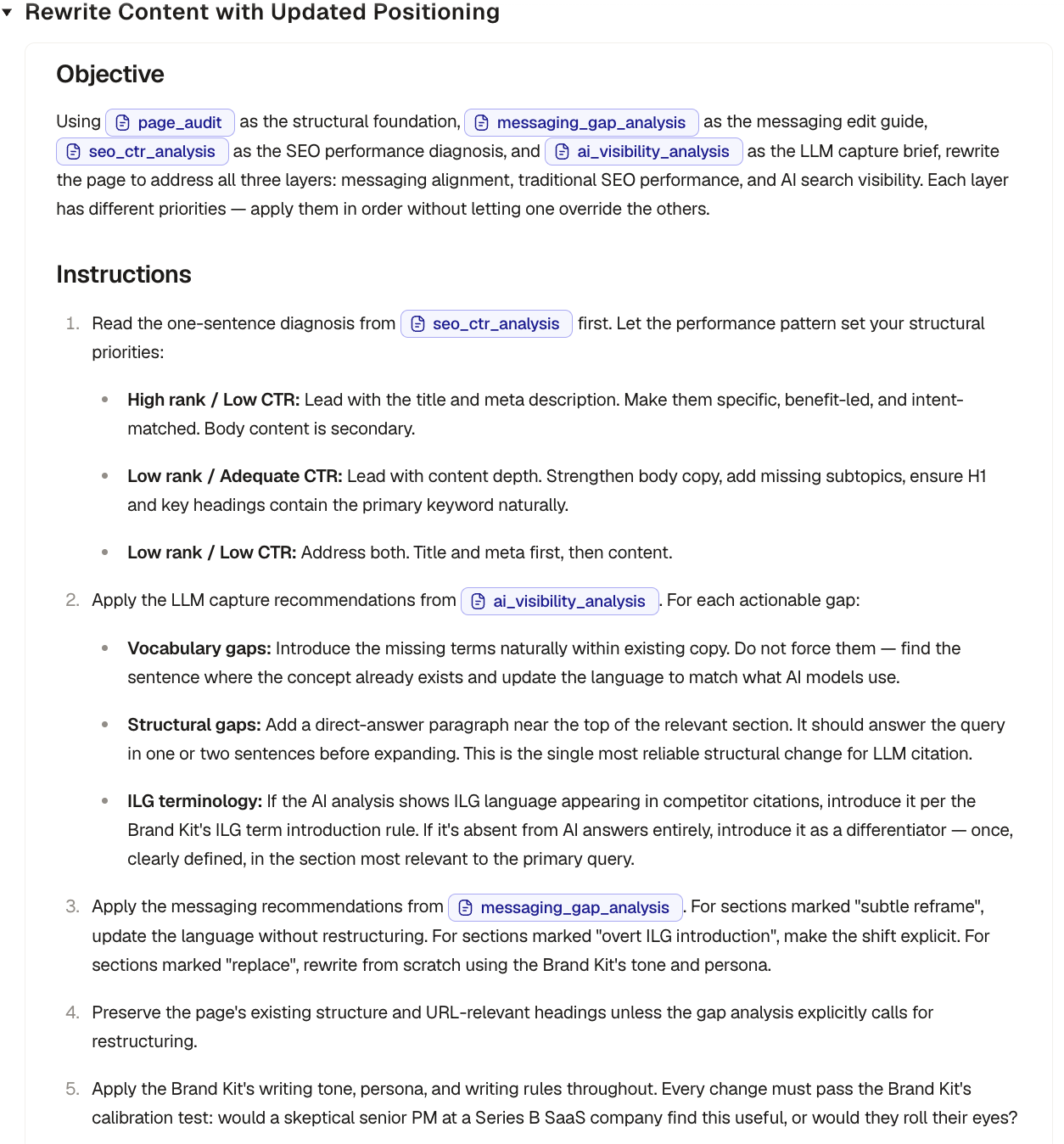
5. What changed
The rewrite draws on all four analyses. The SEO diagnosis sets structural priorities, the AI visibility findings shape vocabulary and structure, and the messaging analysis drives the shift in tone. Every rewrite ends with a summary of what changed, split into messaging, SEO and LLM-capture updates, so reviewers can see what moved and why.
6. Human review
Nothing is published automatically. Every rewrite goes through human review before it’s finalised and republished.

05. LLM visibility
We made LLM visibility a priority in its own right, tracking not just whether Jimo’s pages were cited as sources, but whether Jimo was named in the answer itself.


We started with the technical foundations. An audit identified opportunities to improve both SEO performance and LLM visibility, and we applied proper schema markup, direct answers and clear article structure so content could be crawled and indexed optimally.
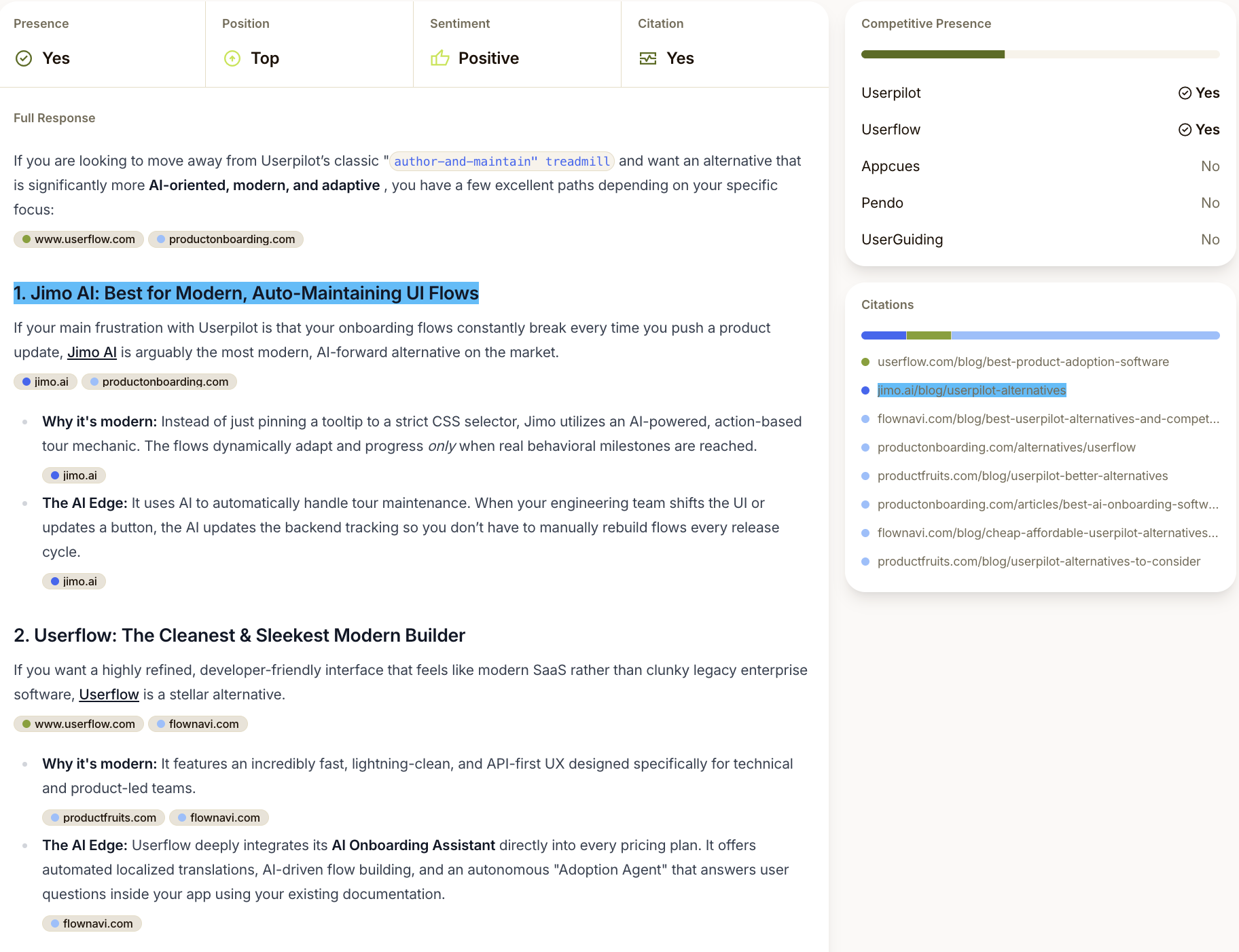
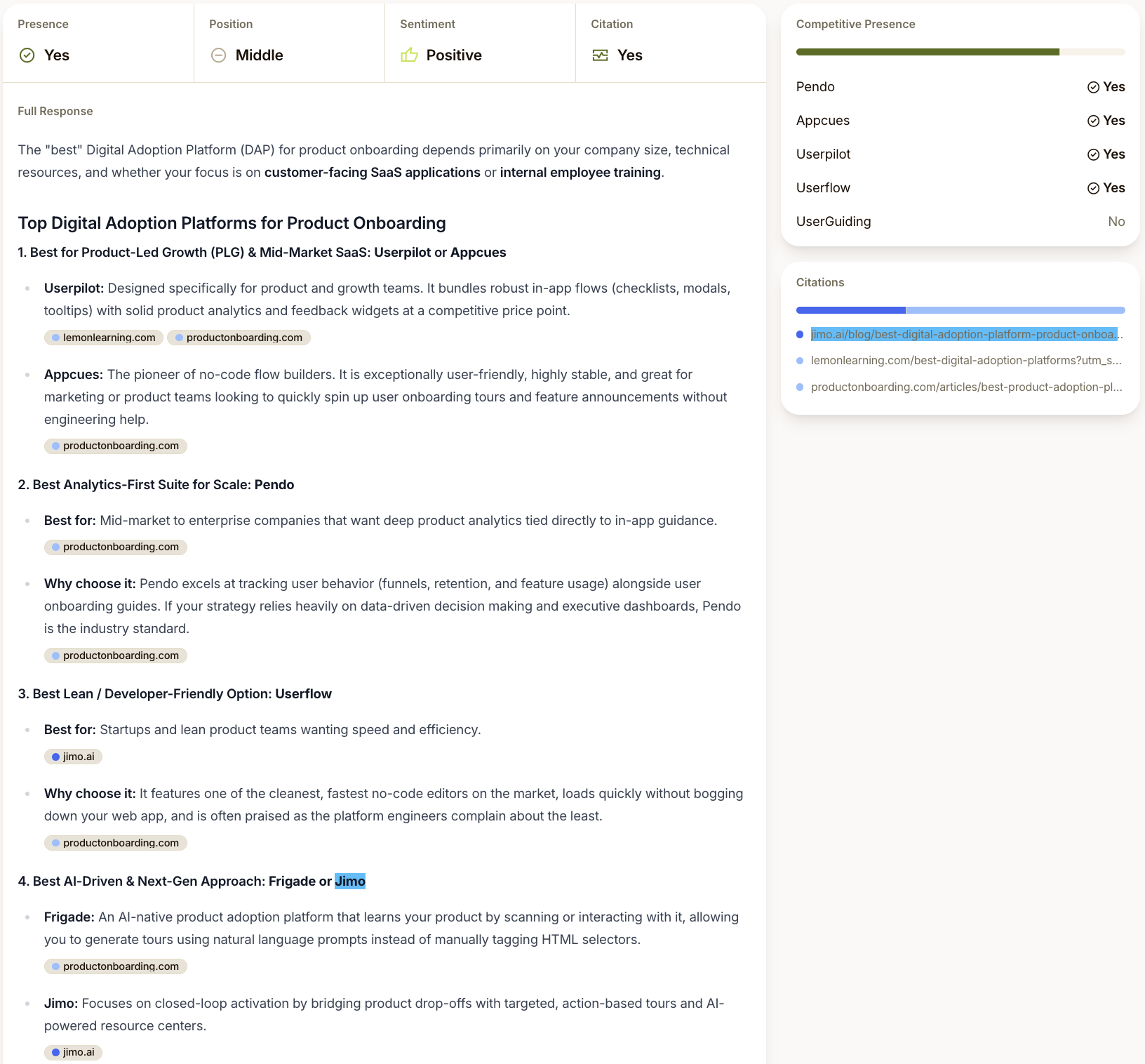
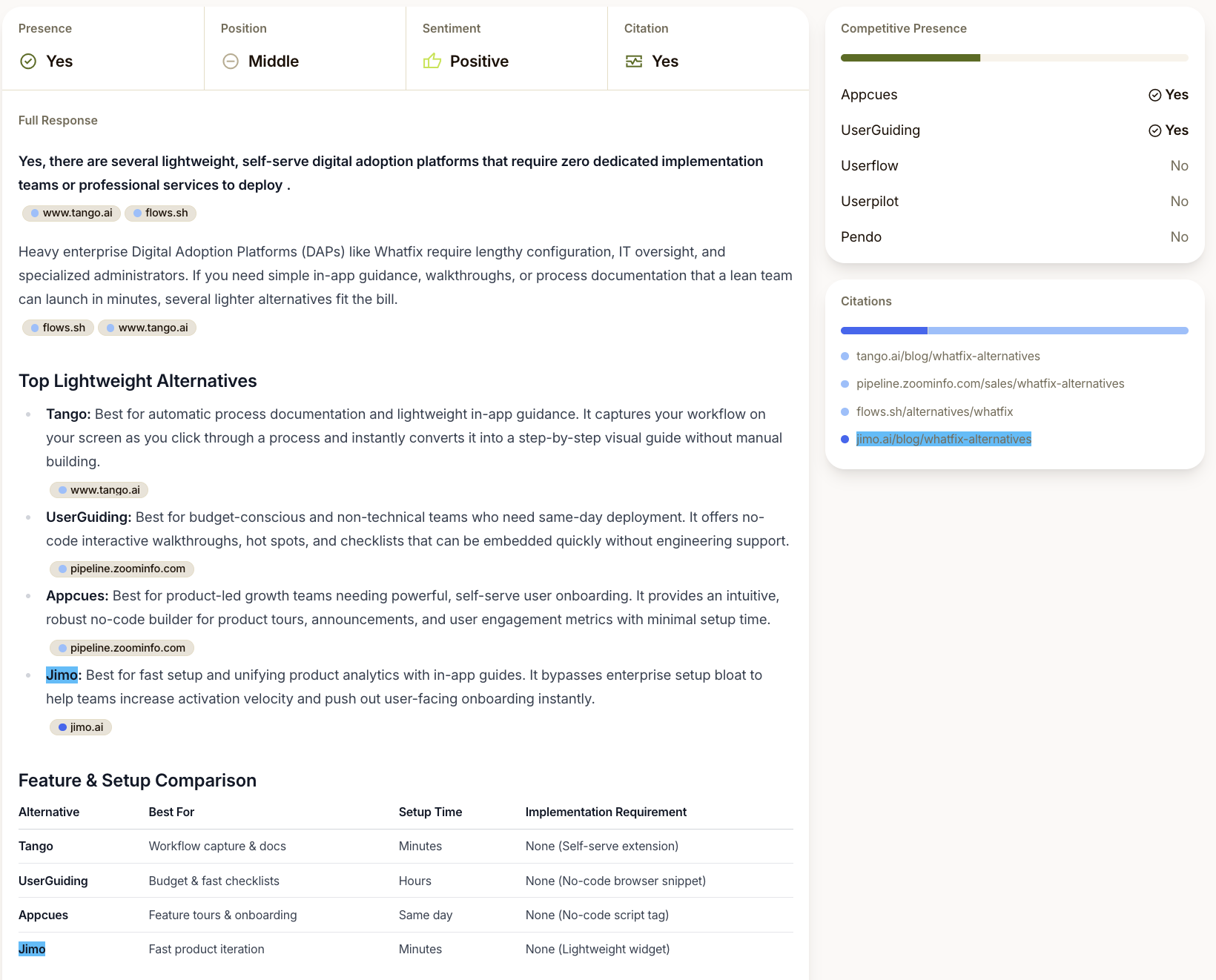
From there, we monitored Jimo’s presence across 374 custom prompts in ChatGPT, Claude, Google AI Overviews and other LLMs. Prompts like “which Userpilot alternative is more AI-oriented and modern” (23.9% citation rate), “what is the best digital adoption platform for product onboarding” and “is there a lighter alternative to Whatfix for a team without pulling engineering time” (9.2% citation rate) showed consistent visibility in the weeks after publication.
Example #1 (AI Overviews)
For the prompt “which Userpilot alternative is more AI-oriented and modern”, Jimo’s article (written by SaaStorm) is cited as a source, and Jimo is positively mentioned in the answer itself.

Example #2 (Gemini)
For the prompt “what is the best digital adoption platform for product onboarding”, the response cites Jimo’s article (written by SaaStorm) and mentions Jimo positively.

Example #3 (Google AI Mode)
For the prompt “is there a lighter alternative to Whatfix for a team without pulling engineering time”, Google AI Mode cites one of Jimo’s articles and mentions Jimo positively.

06. External linking strategy
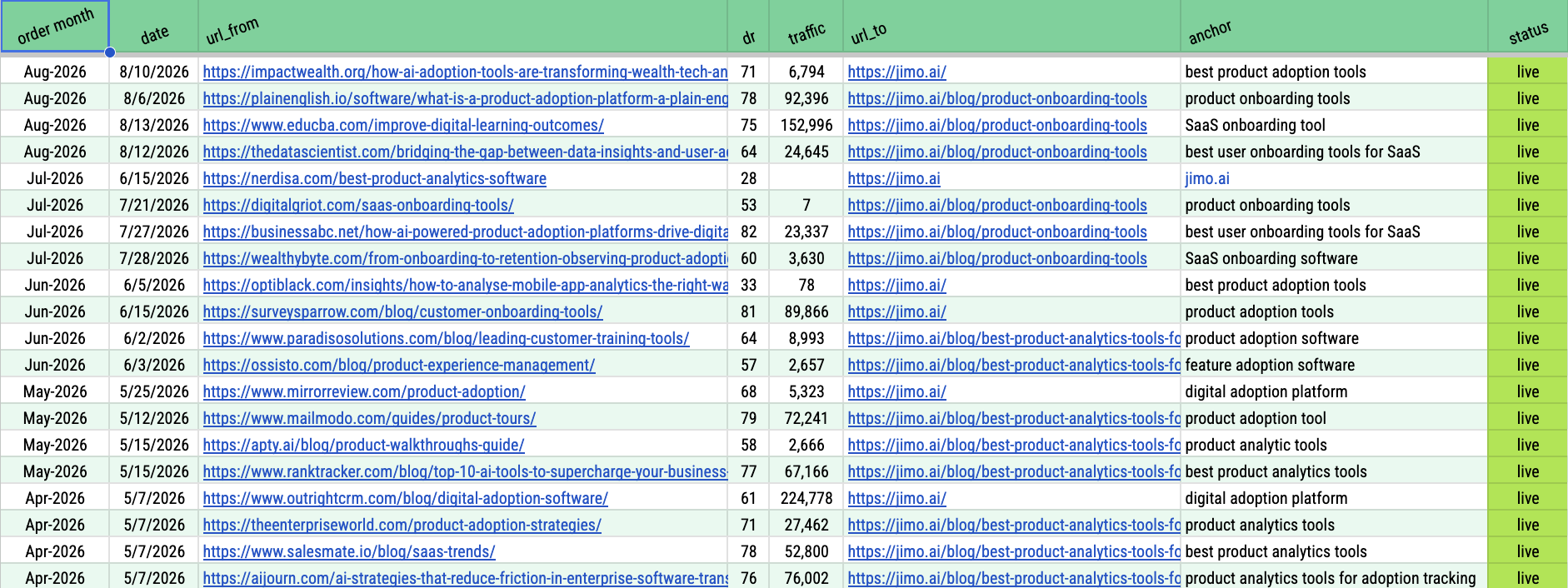
Finally, we mapped out an external link-building strategy to strengthen the authority of Jimo’s most important pages, focusing on the homepage and the commercial pages central to the strategy.
“We knew we didn’t have the same budget as other competitors in the market. It was very David vs. Goliath, so we doubled down on strategy: refining our language around the buyer, understanding what mattered to Jimo’s ICP, and building content systems that could compound over time. That was how we planned to chip away at the barrier to getting Jimo into organic conversations.”
Courtney Hopkins, Organic Growth Strategist at SaaStorm
The results
Seven months in, Jimo had a measurable inbound engine powered by 93 articles, 50 glossary pages and a targeted link-building strategy.
Here’s how the numbers break down:
- 43 MQLs generated during the partnership
- 17 MQLs from LLM search, driven by content built around real customer pain points
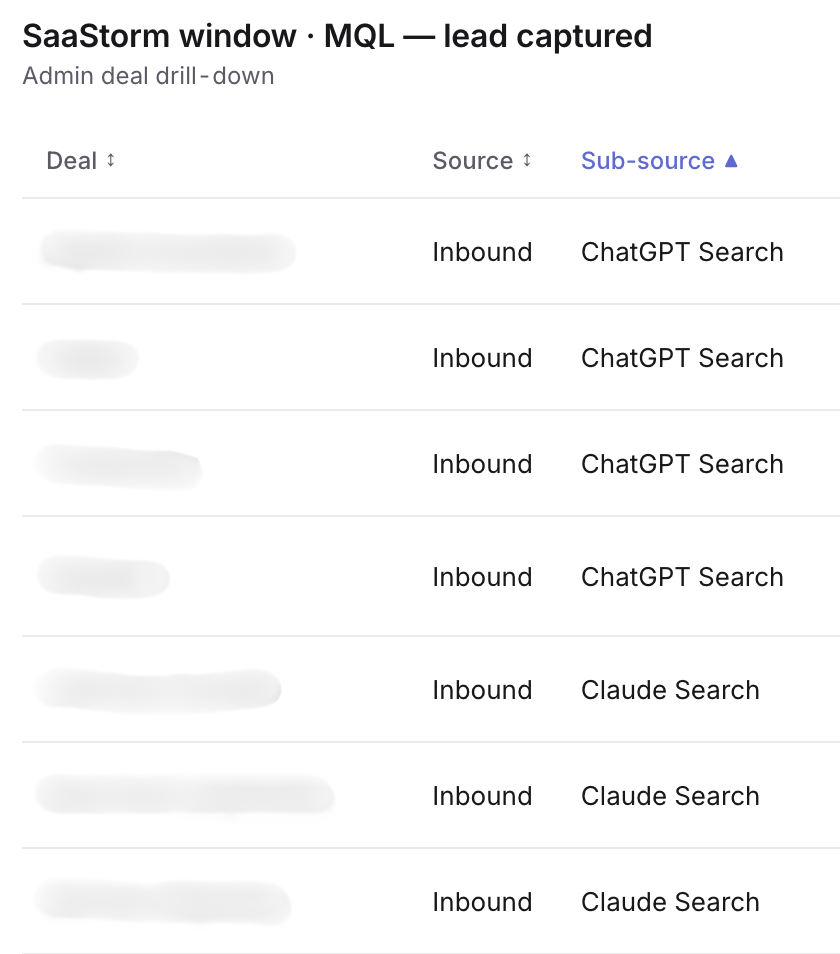
- €100K in qualified pipeline, from zero, generated through Google and AI search
- €16K+ in closed-won ARR from three deals

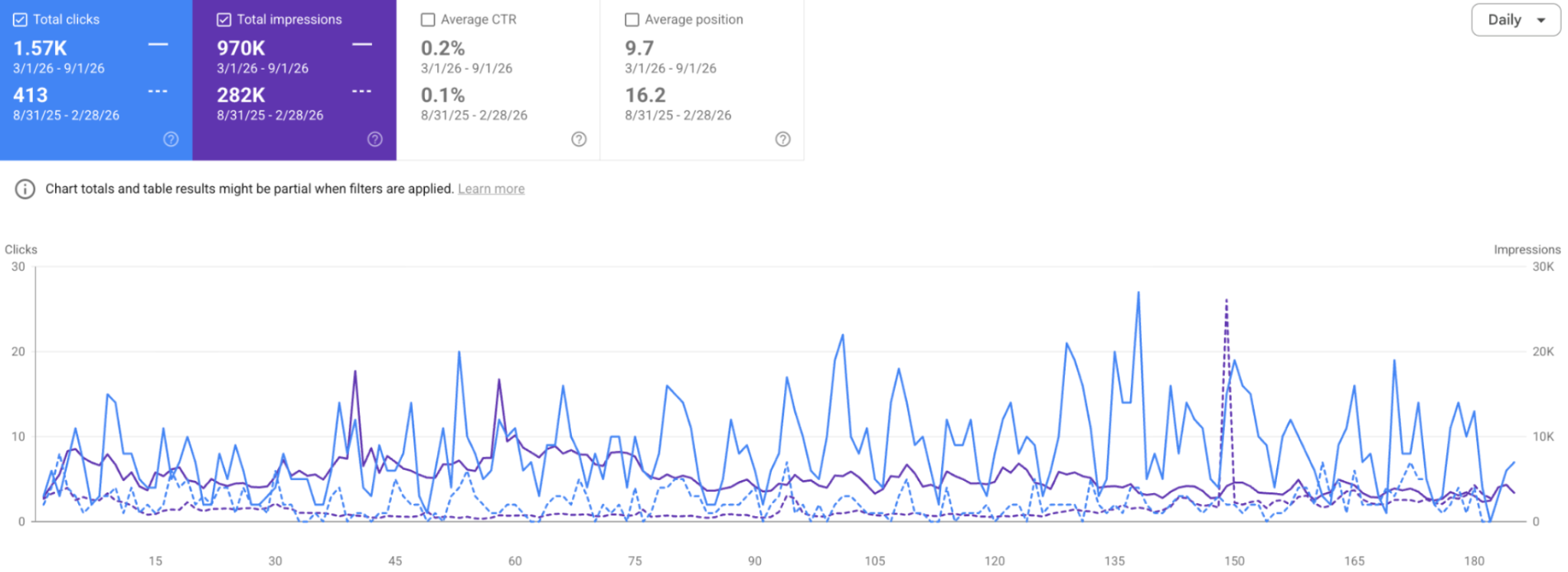
- +280% blog clicks, from 413 to 1.57K, by publishing and optimising 93 articles around strategically selected topics
- +244% blog impressions, from 282K to 970K, by expanding coverage across previously underrepresented topics
- Average position improved from 16.2 to 9.7, thanks to topically relevant content built to perform
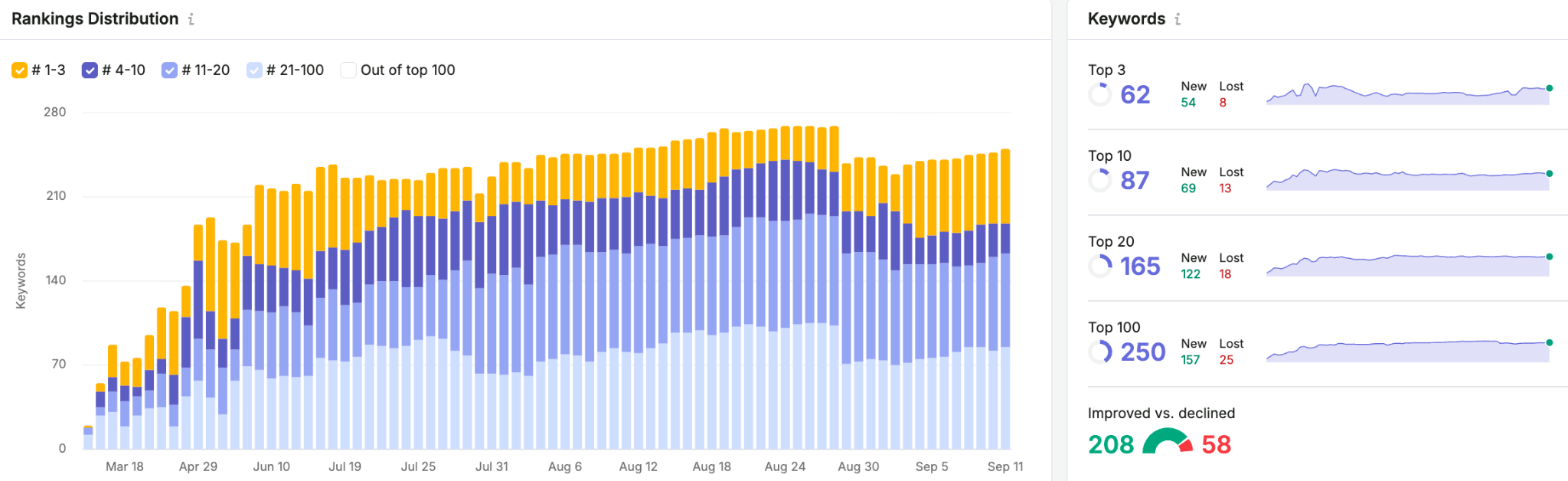
- 62 top-3 keywords, with content securing prime positions in Google and AI Overviews
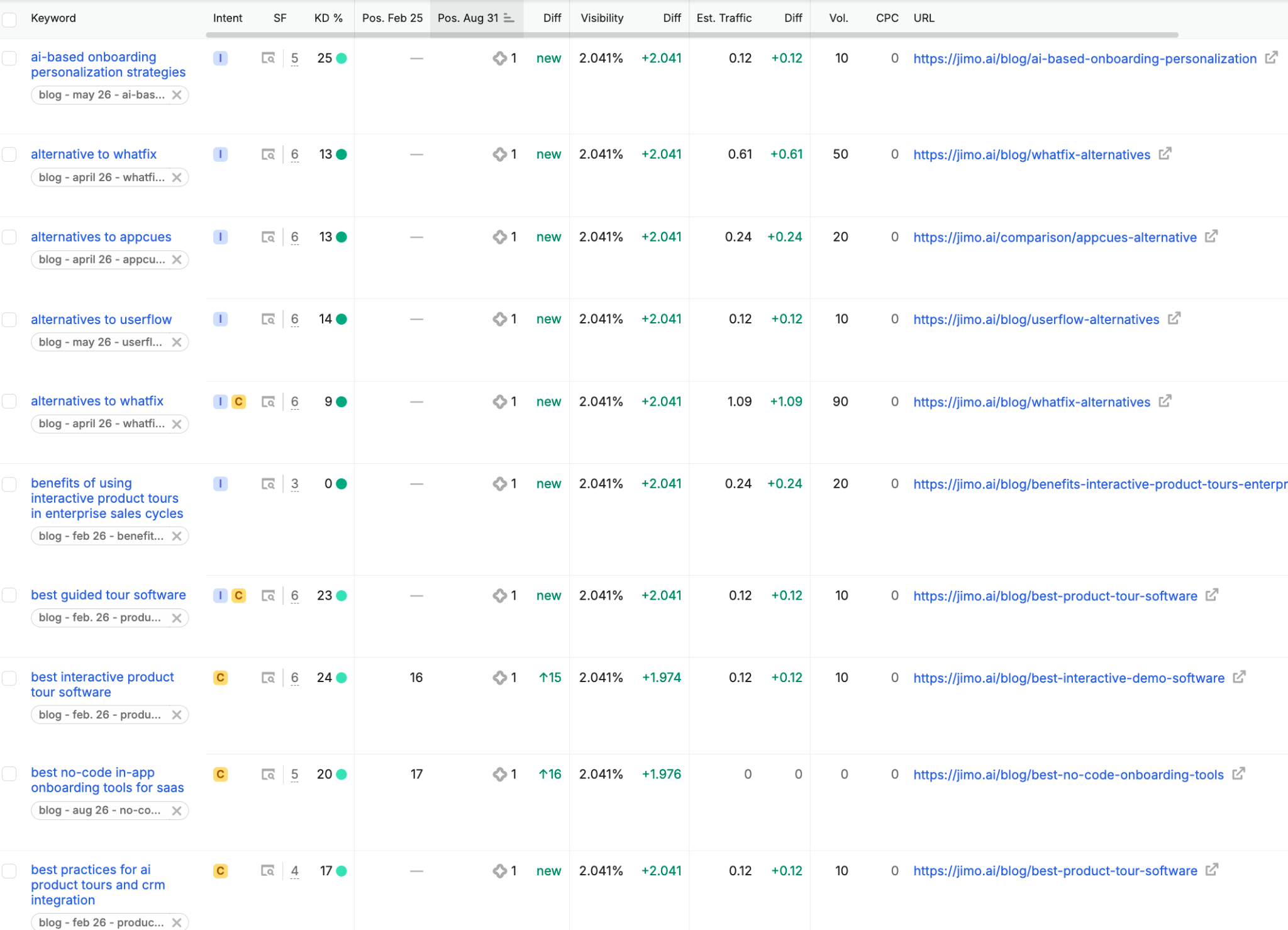
- 165 top-25 keywords, proof that focused content can compete with larger players, attract the right ICP and drive highly qualified traffic
Conclusion
Jimo didn’t need to outspend larger competitors to win in search. They needed a sharper strategy, stronger content, and a way to turn that visibility into demand.
Over seven months, that’s exactly what we built: an inbound engine anchored to the questions Jimo’s buyers were actually asking. Not vanity traffic, and not content for content’s sake. Pipeline.
This is what happens when content, AI-assisted execution and commercial insight work together. Search becomes a revenue channel.
















.png)