
“What stood out most was their focus on revenue, not just SEO metrics.”



Asora was solving a real problem for UHNW individuals and lean single family offices, but reaching that audience online was far from straightforward. They had a strong product and a clear market need, but their ideal buyers were not searching in one obvious category. They were researching through a mix of problem-led and comparison-led queries, from replacing Excel to comparing family office software.
That meant broad awareness was never going to be enough. Growth had to come from high-intent search, comparison-led content, and visibility in LLM answers, where more buyers now start their research. On top of that, Asora’s content engine and website still needed important work, from publishing consistency and technical SEO to UX, migration planning, and conversion paths. The goal was not just to grow traffic, but to build a revenue-driving inbound engine that could turn specialist demand into qualified leads, pipeline, and closed business.
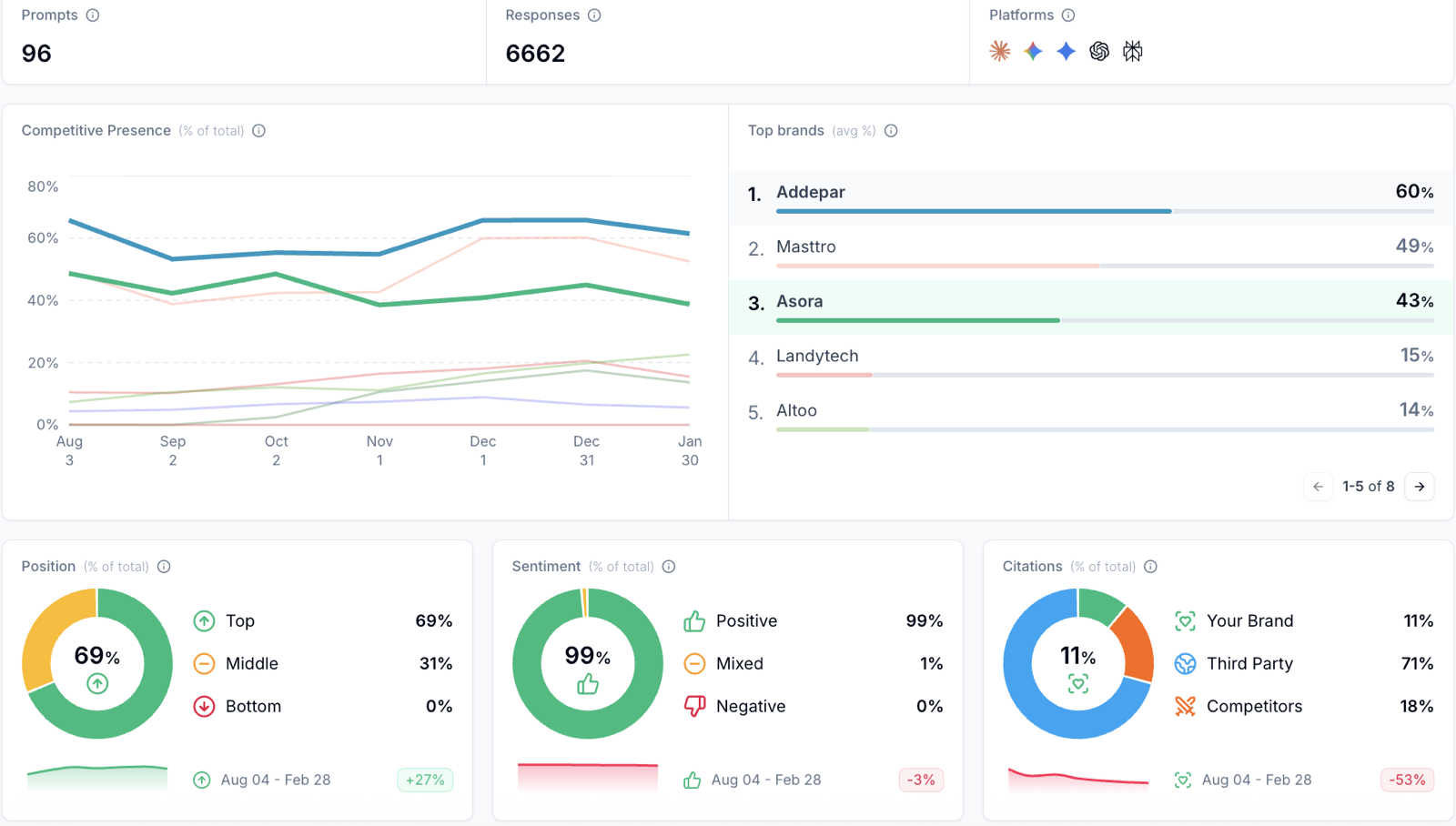
Fast forward nine months, and that strategy turned into measurable commercial impact. By the end of the partnership, Asora had generated a €20M qualified pipeline and added €2.2M in new ARR across 17 new clients. With 42k+ cumulative website visits, 360 MQLs, and visibility in 43% of tracked LLM answers, Asora’s inbound engine became a consistent source of qualified leads, pipeline, and closed-won revenue.
Impact


The challenge
Asora, a modern wealth platform for ultra-high-net-worth individuals and lean single family offices, needed a stronger inbound engine to reach a very specific, high-value audience. Before we started working with Asora, their organic presence was limited. In the six months prior to our partnership, they averaged around 590 clicks and 62,600 impressions per month, with an average position of 34.6 and a 0.9% CTR. The trend was flat, some months dipping, with no clear growth trajectory. For a SaaS business with a strong product, the organic channel simply wasn’t pulling its weight.
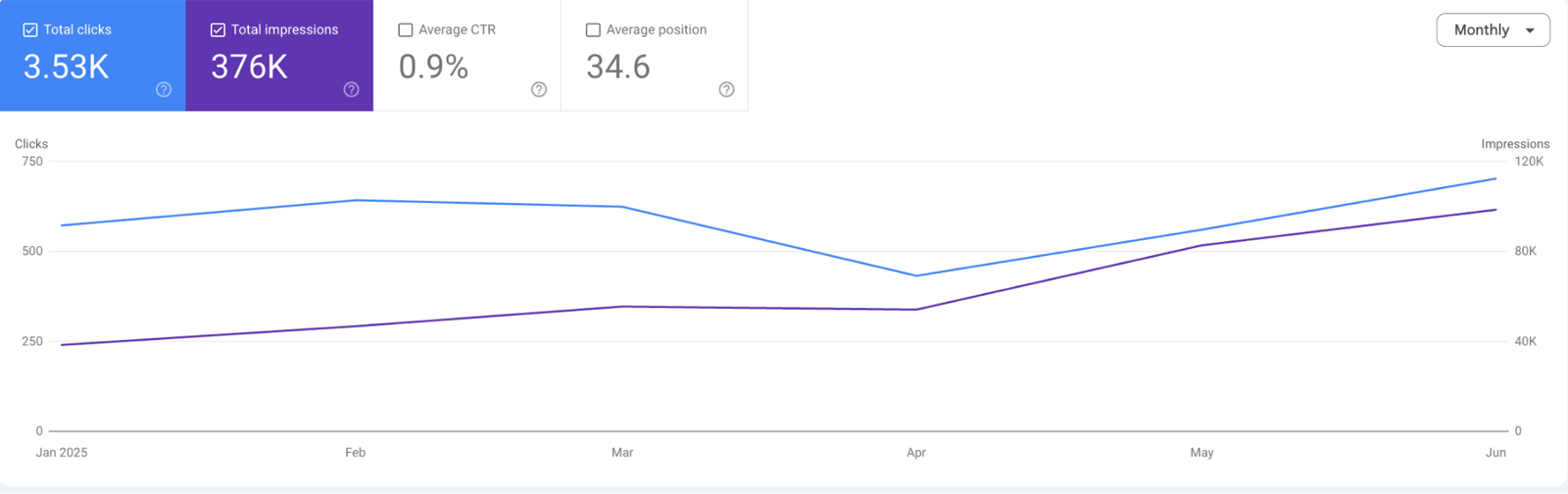
They needed more than a few new articles. They needed a strategic partner to sharpen their positioning, build content around the problems their buyers were actually searching for, and turn the blog into a real demand driver. That included not only educational content, but also higher-intent, evaluation-stage pieces such as competitor comparisons and “best family office software” style content that could capture buyers closer to a decision.
The foundation was there, but much of the content still needed keyword optimization, and the blog itself needed stronger search and conversion elements. Many posts were missing features that help both rankings and usability, including clear keyword targeting, above-the-fold TL;DRs, structured FAQs, stronger internal linking, and more deliberate calls to action. Asora needed a content engine that could build visibility, support evaluation, and attract the kind of traffic most likely to turn into a qualified pipeline.
The solution (SaaStorm’s approach)
The engagement started with a 2-week discovery phase focused on Asora’s market, content, website, and growth potential. The aim was to understand Asora’s positioning, where competitors were winning, and where the biggest gaps sat. We also mapped what Asora needed to build an inbound engine that could attract the right audience and convert that demand into pipeline. During this phase, we reviewed internal materials, recordings, presentations, and the website, analysed Asora’s existing content, and benchmarked the business against 30+ competitors.
From there, we turned the research into a clear execution plan. We identified 7 high-potential topic clusters representing 41K+ monthly US search volume, built a 114-topic SEO content plan, and prioritized 79 topics for production alongside 29 existing articles for optimization. We also mapped the internal linking structure, outlined an external link-building strategy, audited the site’s technical health, and flagged conversion and UX improvements across key pages.
Here’s what we delivered:


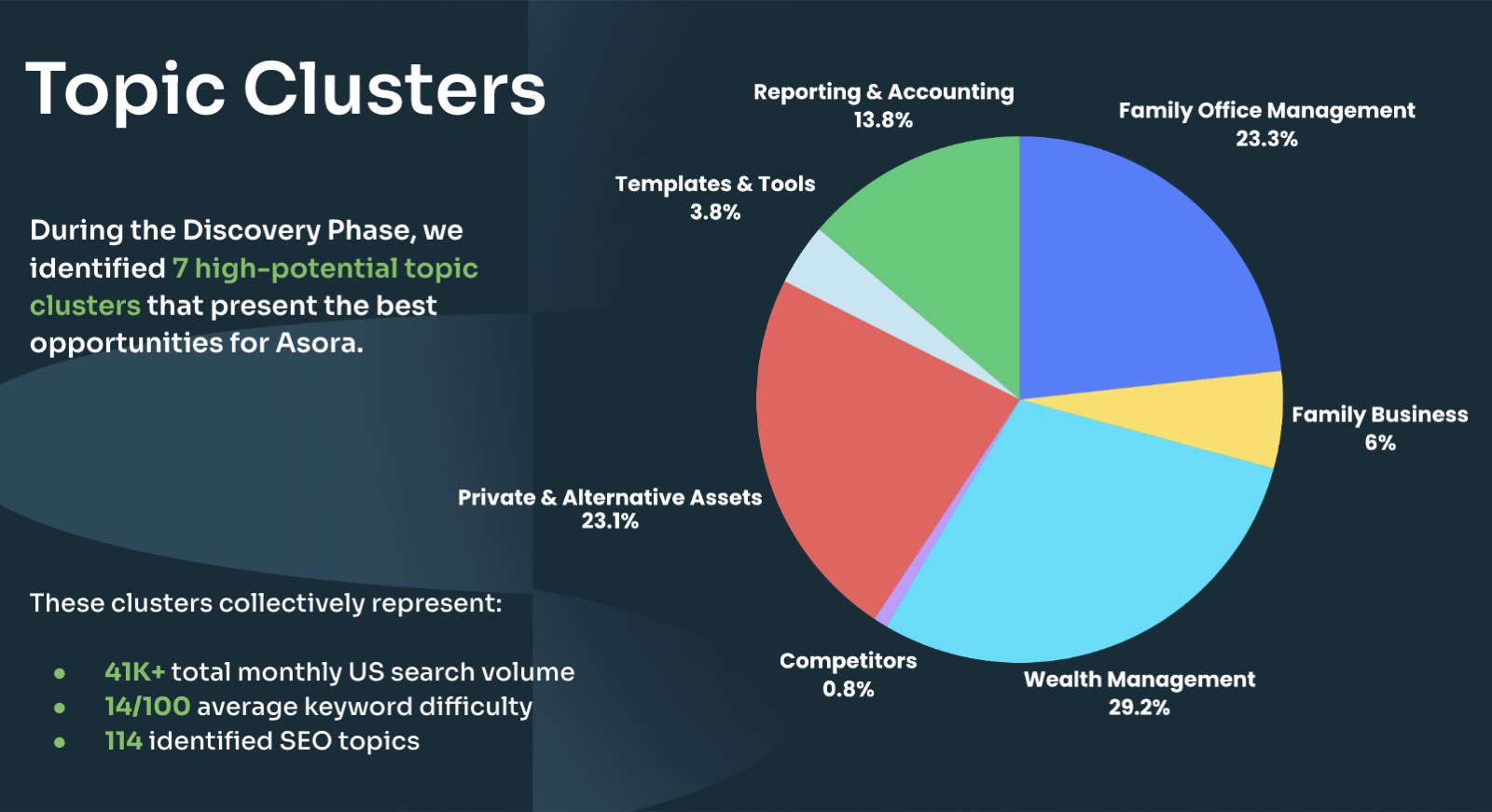
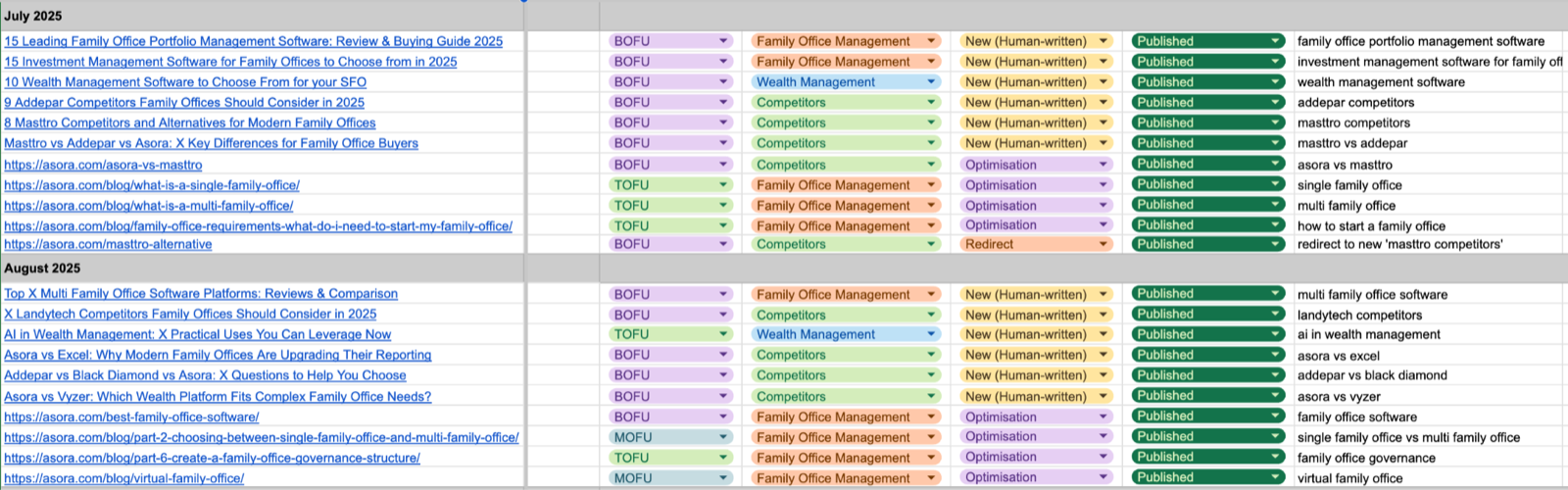
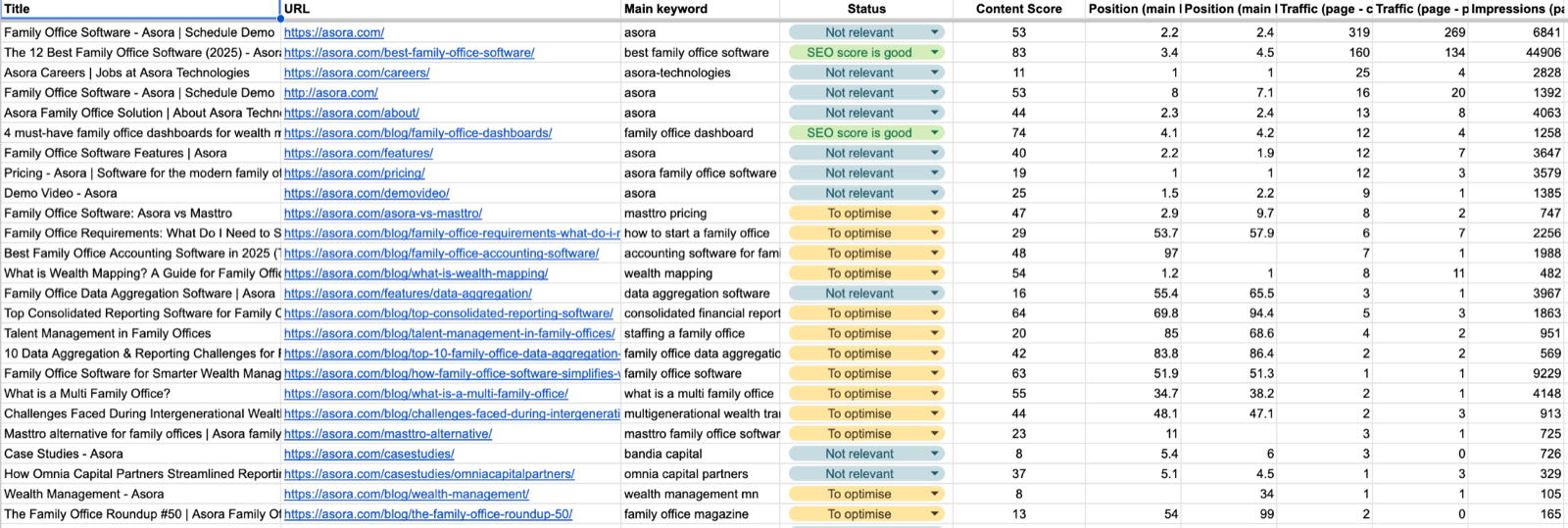
The result was a practical, data-backed plan Asora could execute with confidence. It was a plan that gave the team clarity on where to focus, what to publish, what to fix, and how to build an inbound engine strong enough to support long-term growth. That roadmap became the foundation for the work that followed.
The SaaS content strategy for Asora
Once discovery was complete, the focus shifted from planning to execution. For Asora, that meant building an inbound engine around the way lean family offices actually research software. We rolled out a mix of human-written articles, AI-assisted content, existing content optimization, downloadable templates, link building, technical SEO, and website improvements to help Asora win visibility earlier in the buyer journey and convert more of that attention into pipeline. The strategy also evolved as the data came in, with more emphasis over time on comparison content, trust signals, conversion paths, and pages that could perform well in both search and LLM results.
Here’s how we put that into practice:
01. We built the content engine around search intent
Instead of chasing volume for its own sake, we prioritized content around the problems Asora’s ICP was already searching for. In discovery, we mapped 114 SEO topics across seven clusters, selected 79 priority topics for production, planned 29 existing articles for optimization, and aligned the mix across TOFU, MOFU, and BOFU so Asora could capture both awareness and evaluation demand.
02. We combined human-written, AI-assisted, and reusable content formats
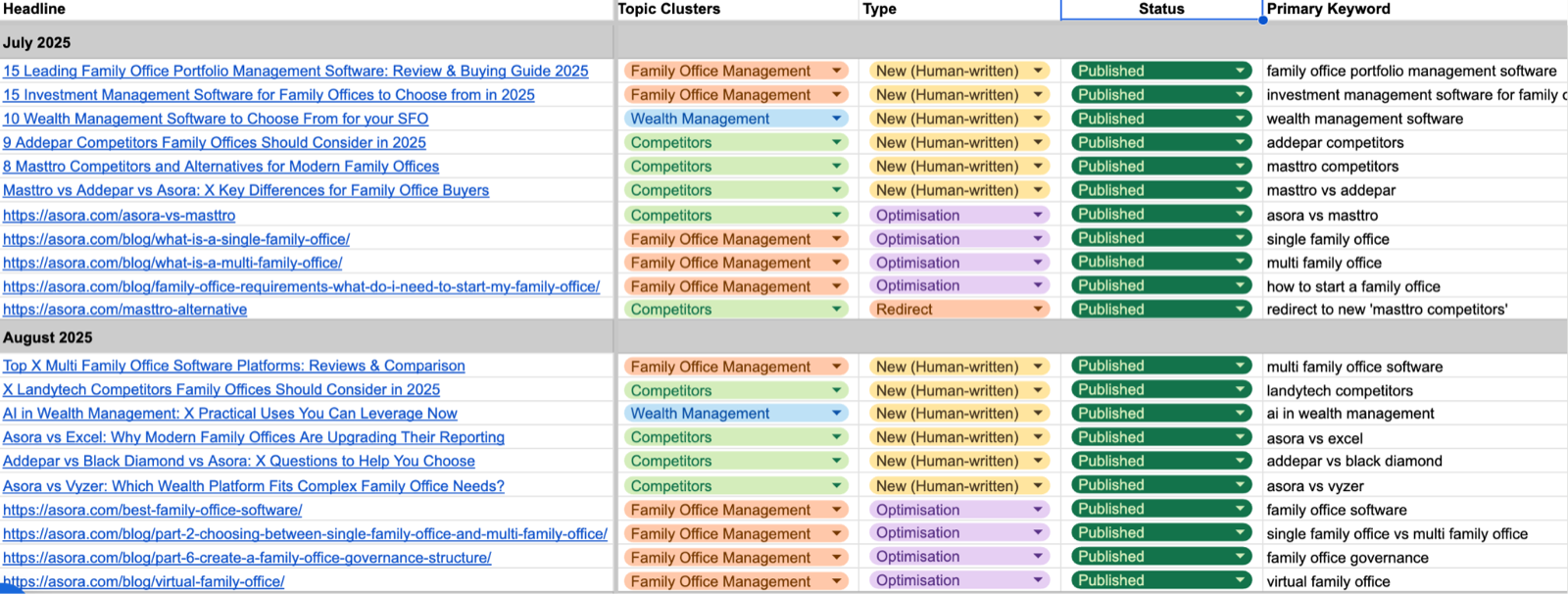
Over the partnership, we published 56 human-written articles, 12 AI-assisted articles, and 11 templates to help Asora capture demand across different stages of the buyer journey. That mix gave the team both scale and flexibility, with human-written content for more nuanced topics, AI-assisted pieces for efficient output, and templates built to attract higher-intent visitors.
03. We treated optimization as seriously as new production
This was not a publish-and-move-on program. Discovery also showed that 67 of 100 pages could be optimised, rewritten, or merged. Over the partnership, we prioritized the 29 highest-impact articles for optimization, helping Asora strengthen existing content as well as expand its library. We rebuilt internal links, tracked rankings in Semrush, and used content scoring on Surfer SEO to raise quality over time.
04. We built authority off-site as well as on-site
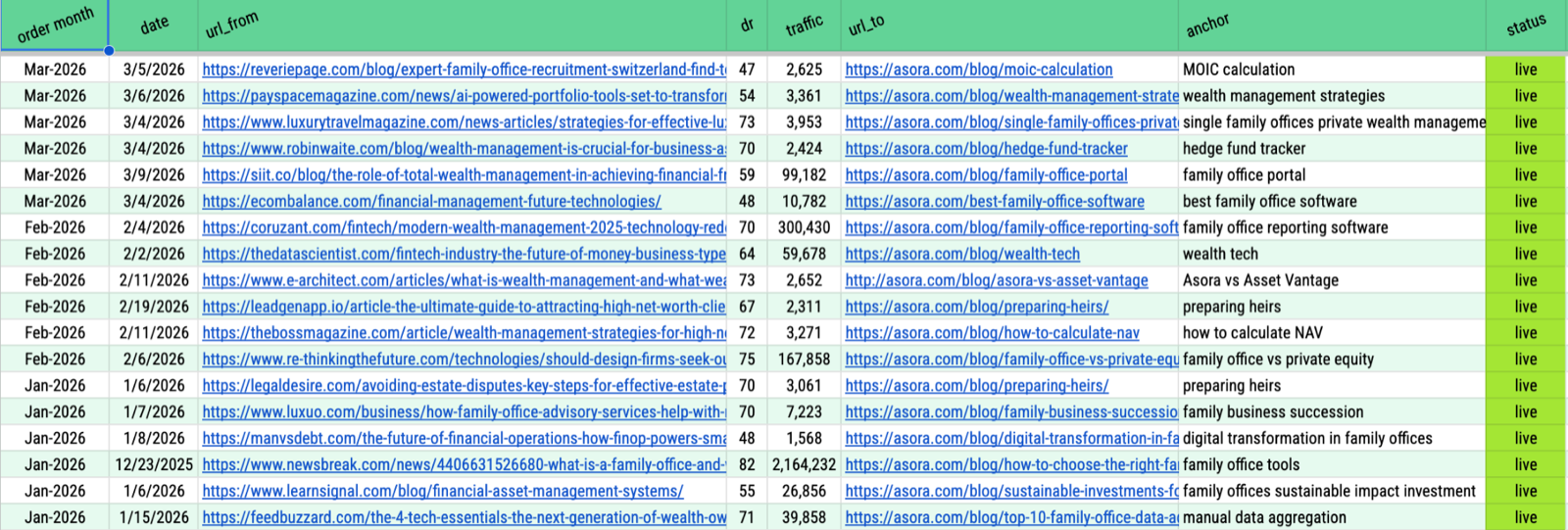
Alongside content creation, we ran a sustained link-building program. We reached 54 backlinks with an average DR of 68 by the end of the partnership.
05. We worked on LLM visibility from the start
This was never a Google-only SEO program. We tracked Asora’s visibility across 96 prompts in ChatGPT, Perplexity, Gemini, and Claude, giving us a clear view of how the brand was appearing in AI-generated answers. We then used those insights to shape the strategy over time, prioritising comparison pages, “best software” content, templates, and other high-intent assets that could earn visibility in both traditional search and LLM citations.
06. We optimized the blog layout for high-intent conversion
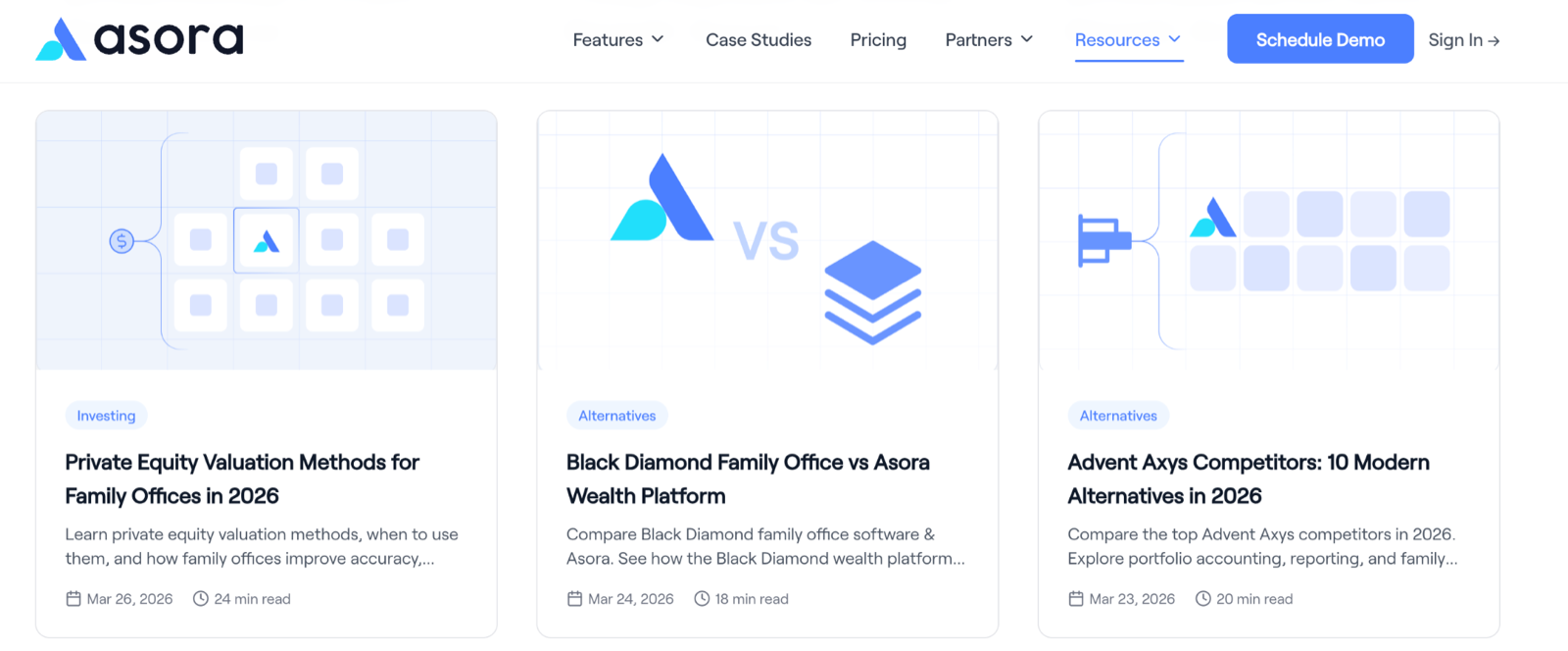
To capitalize on rising traffic, we redesigned the blog experience to include strategic banners throughout the content. This change created a direct path for readers to engage with the product and accelerated the journey from visitor to lead. We also designed custom, branded inner images for every published article to ensure a premium, cohesive visual experience that keeps readers engaged and professionalizes the brand’s aesthetic.
07. We improved the website, not just the blog
For Asora, the work extended well beyond content production. Discovery uncovered both technical SEO issues and conversion gaps across the site, from metadata and site health problems to weaker blog UX, CTAs, and supporting trust elements. Over the partnership, we turned those findings into hands-on improvements across technical SEO, migration support, blog and case study page updates, inner blog visuals, template hub development, and higher-intent pages built to convert BOFU traffic more effectively.
08. Ongoing SEO optimization
Our work didn’t stop once the content was published. We continuously optimized Asora’s site with regular performance audits, updated internal linking strategies, and refreshed content to keep it competitive as Google’s algorithms evolved.
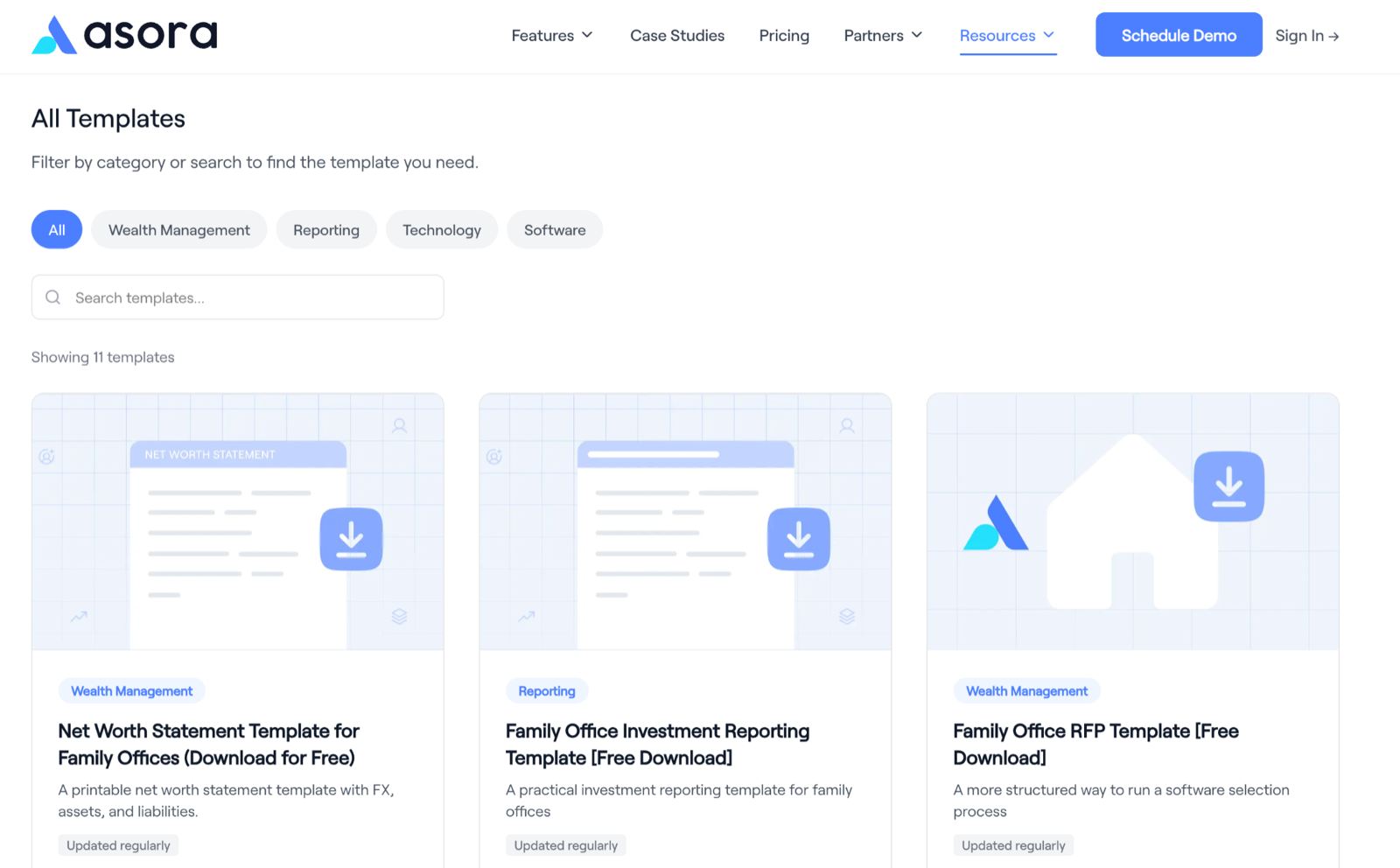
09. We launched a Template Hub with 11 high-value resources
We built and deployed a dedicated Resource Hub featuring 11 custom templates. By providing value, these templates establish Asora’s authority and turn the website into a functional toolkit for potential buyers.
The results
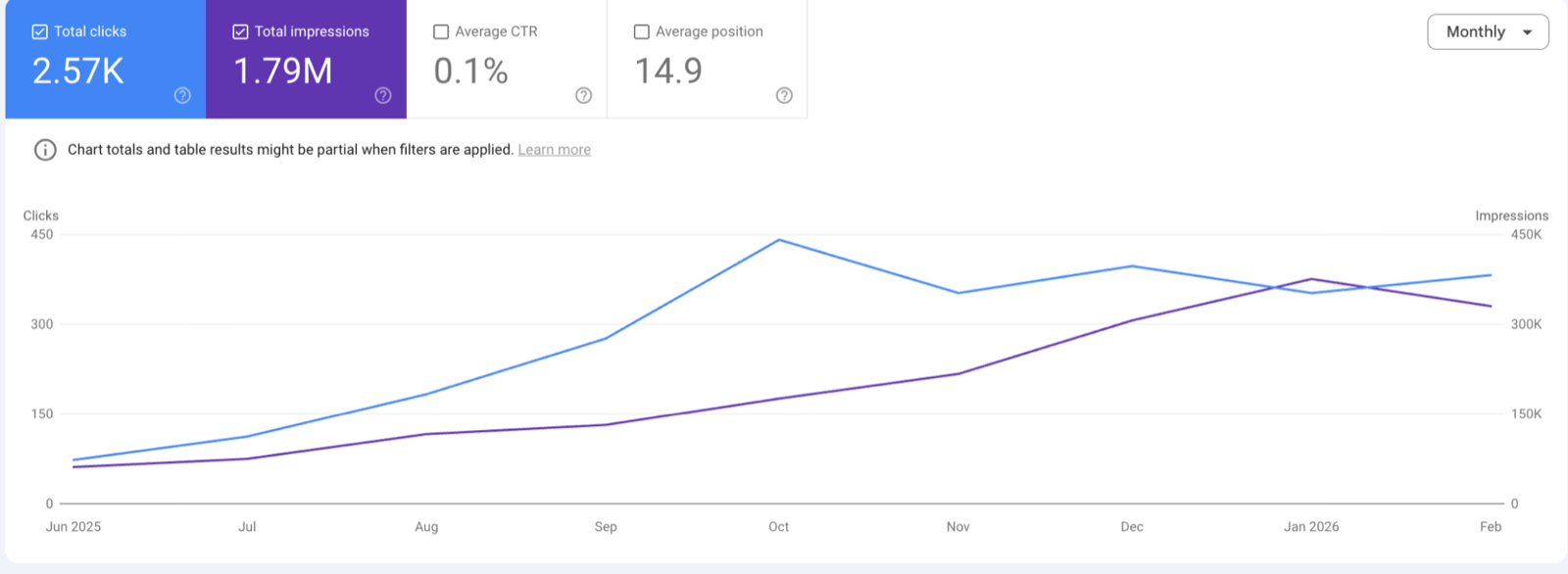
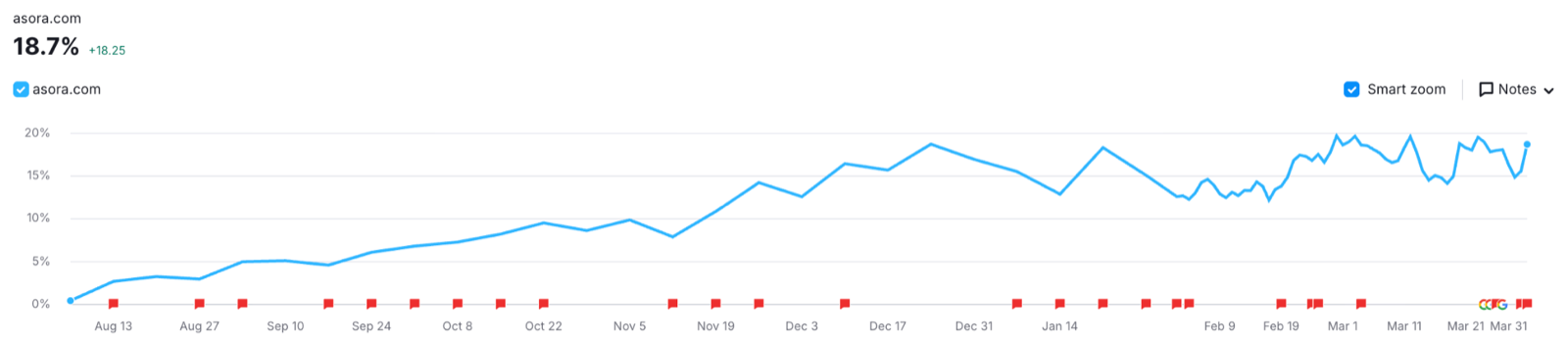
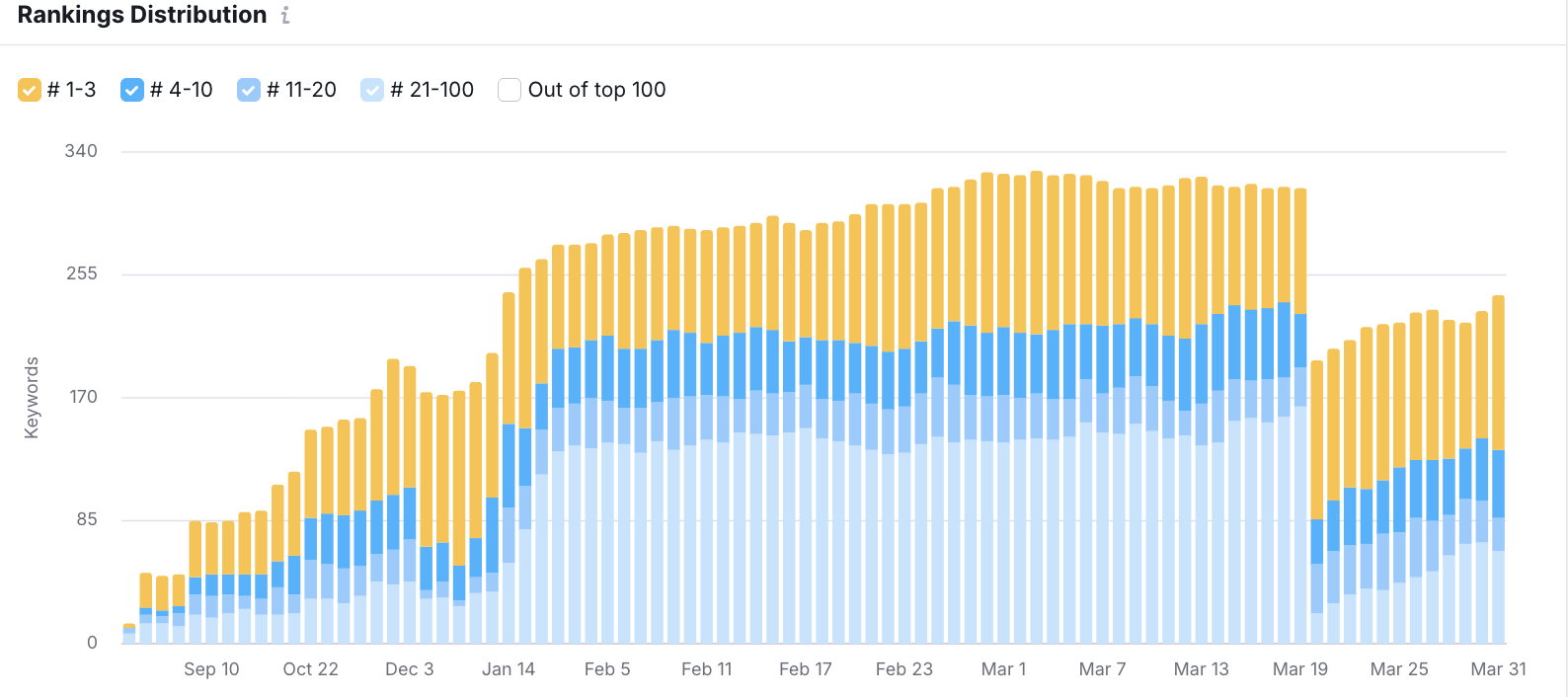
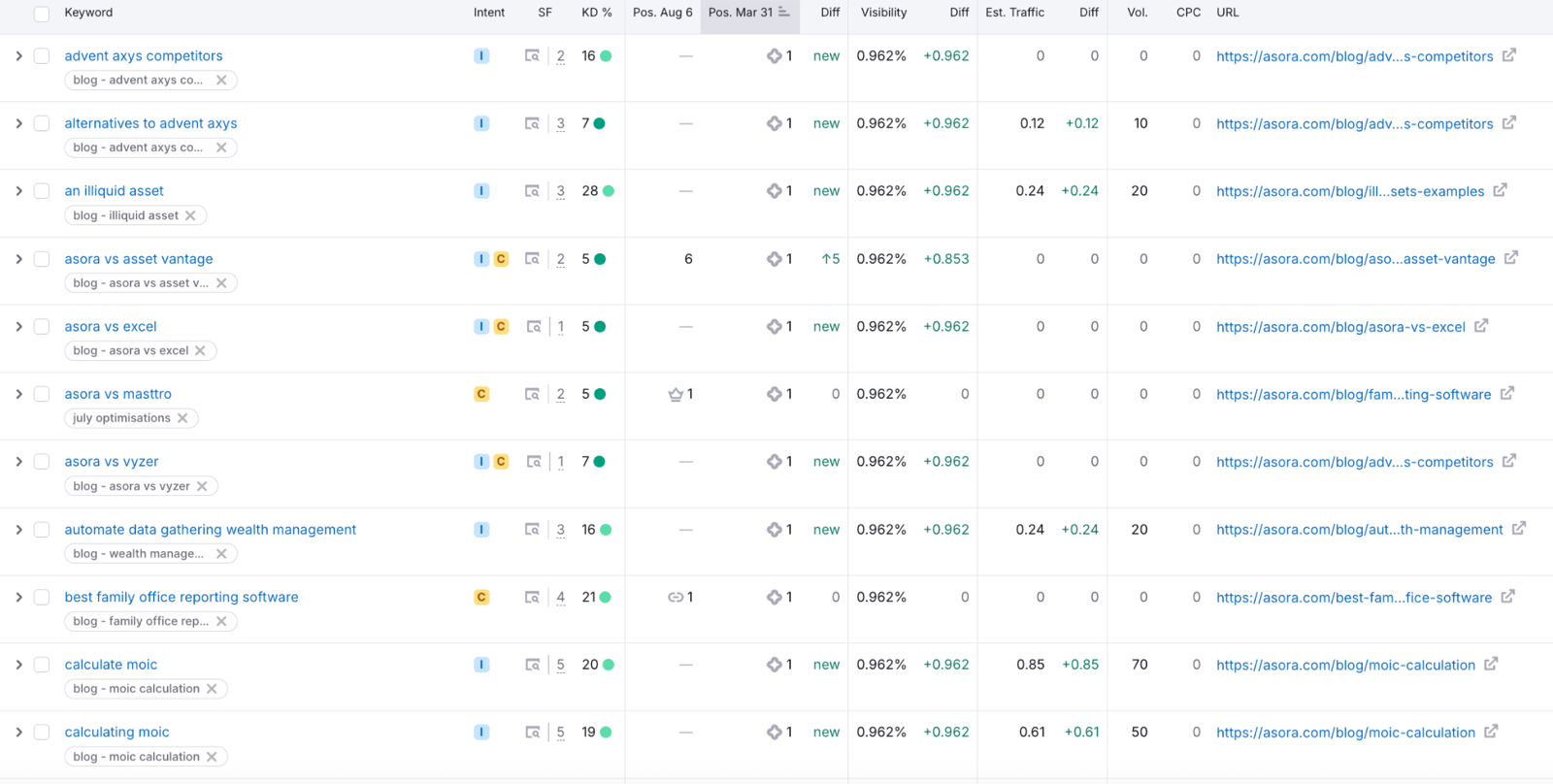
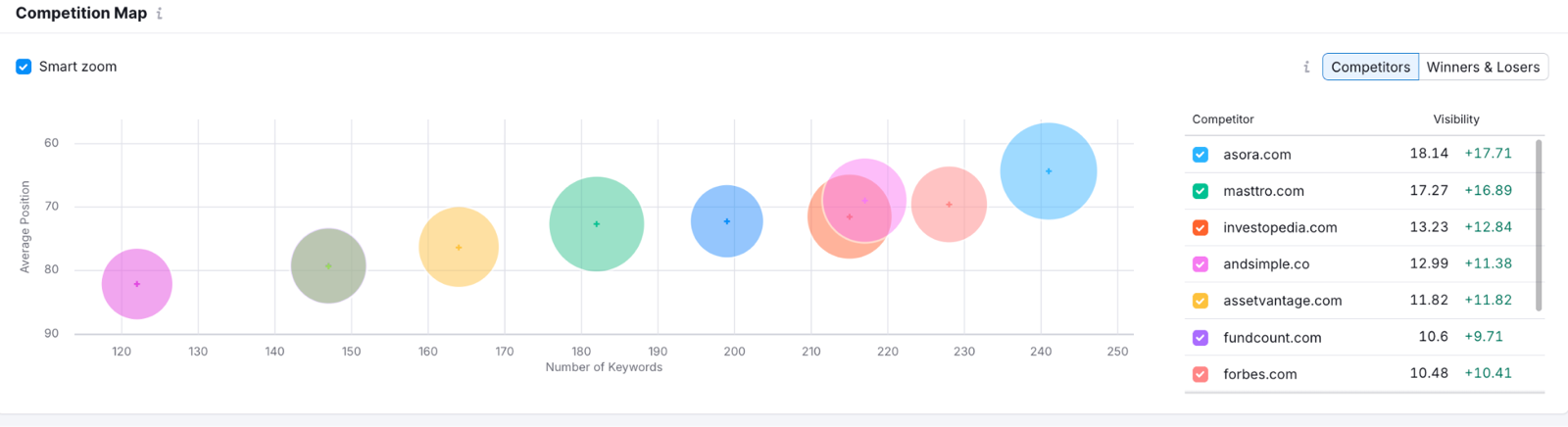
The numbers speak for themselves. In just 9 months, Asora had turned SEO, content, and website improvements into a meaningful growth channel:




A closely connected partnership
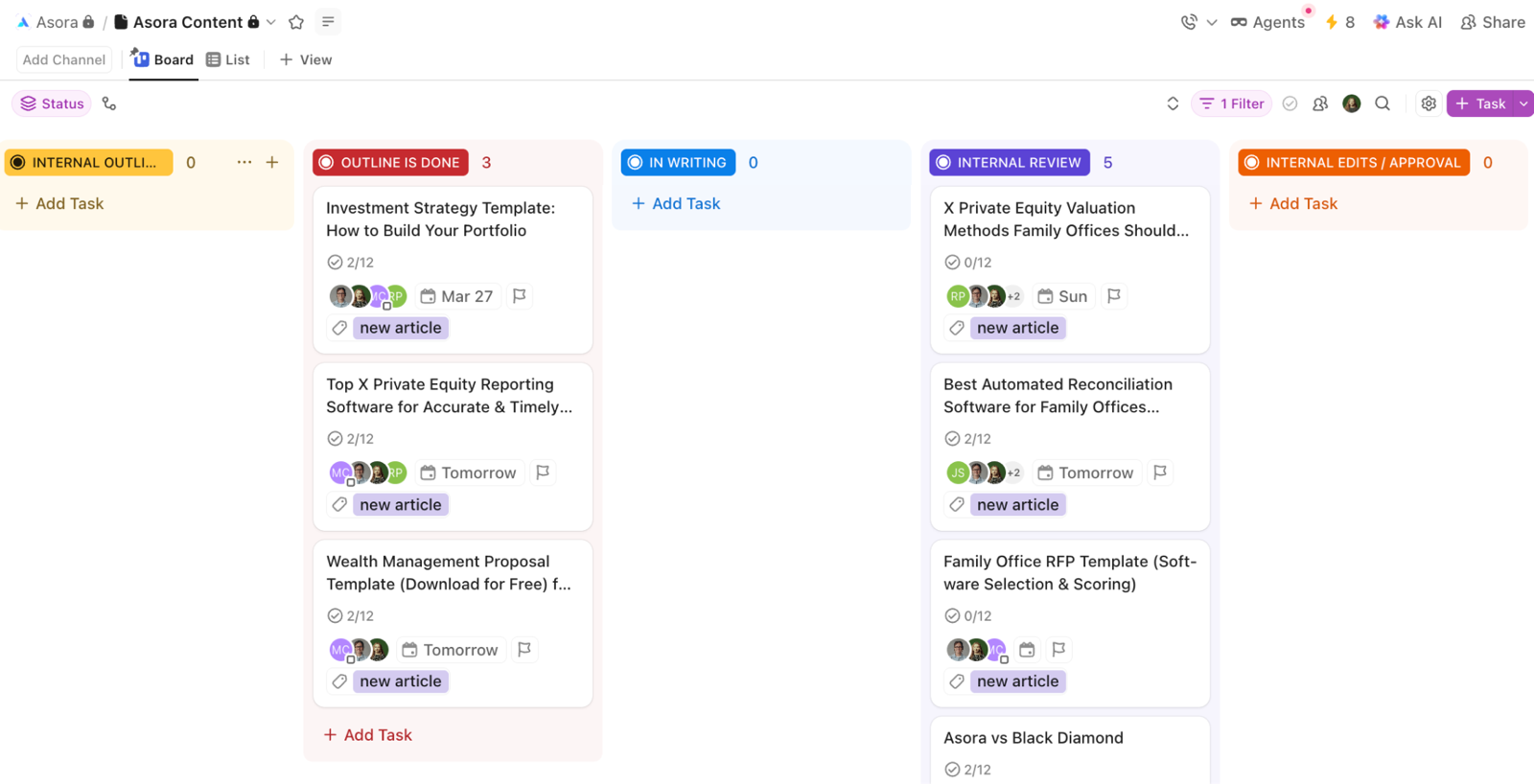
We worked hand in hand with Asora’s Marketing Executive and stayed closely involved with the CEO throughout the partnership, which kept strategy tied to commercial goals rather than drifting into isolated SEO work. We had weekly calls to stay aligned, used ClickUp to manage execution, and shared monthly reports so the team always had a clear view of performance, priorities, and next steps. The collaboration was practical and hands-on from the start, with early alignment meetings around positioning, revenue goals, and article direction, followed by ongoing website reviews, design feedback, migration support, technical SEO work, and conversion improvements as the programme evolved.
Conclusion
Asora’s results show what can happen when SEO, AEO, content, link building, and website improvements are aligned around growth from day one. Over the partnership, we helped build an inbound engine that generated qualified pipeline, closed revenue, and much stronger visibility across both search and LLMs.
Along the way, we also strengthened the foundations for long-term performance through clearer positioning, a more robust content engine, improved technical SEO, and pages designed to support the buyer journey more effectively.
For SaaStorm, that is the goal of great SaaS marketing. Helping the right buyers find you, trust you, and take action.
















.png)